I very much enjoyed my first taste of China Miéville, the highly original The City and the City. This novel was billed as an existential thriller with shades of Orwell and Kafka. There’s some truth in this, although what impressed me most was the sheer originality and imaginative scope of this book .
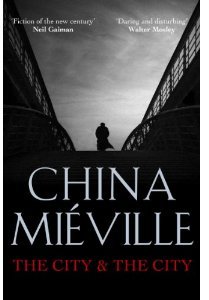 Set in the fictional city of Besźel, the body of a murdered woman is discovered and a detective, Inspector Tyador Borlú, is dispatched to investigate. So far very run of the mill, but Miéville cleverly drops subtle hints that this is going to be far from an ordinary whodunnit. Firstly, we begin to learn of a sister city to Besźel called Ul Qoma. Citizens of each are forbidden to associate, even to look at, one other. Failure to follow this doctrine strictly results in breach, with perpetrators investigated by a sinister body known as The Breach. Miéville begins to unravel a very complex and often challenging premise, daring the reader to keep up with him. It’s this aspect of The City and the City that I enjoyed, whenever you pause for breath this author just keeps running ahead of you with fresh ideas and twists.
The twins Besźel and Ul Qoma and the complexities that result from their division are at first reasonably acceptable. However, as Borlú tentatively begins his investigation, it slowly emerges that citizens of each are not just expected to avoid a neighbouring city. The two inhabit each other; more – they are one and the same from the eyes of a casual – or uninitiated – observer. Streets from each city intersect, even at times forcing traffic to avoid, or “unsee”, traffic belonging to the other city. The act of “unseeing” keeps the respective citizens suitably fearful and repressed. Miéville slowly unravels this ambitious conceit, creating further intrigue when Borlú’s investigation leads him to visit Ul Qoma, unseeing everything he’d previously become accustomed to.
The murder story at the heart of The City and the City is at times overblown and unnecessary, and Miéville is over determined to solve the mystery for us. What’s most impressive is the novel’s extraordinary premise and setting, this odd take on an alternative Eastern Europe, with the close of the book particularly satisfying. Torn between the twin cities, there is only one place that Borlú can go, and his final realisation of this is deftly handled.
The Terrible Privacy of Maxwell Sim
A silence fell between us, and I felt a mounting sense of frustration. Was this what it had come to, my relationship with my own daughter? Was this all she had to say to me? For God’s sake, we had lived together for twelve years: lived together in conditions of absolute intimacy. I had changed her nappies, I had bathed her. I had played with her, read to her, and sometimes, when she got scared in the middle of the night, she had climbed into my bed and snuggled up against me. And now – after living apart for little more than six months – we were behaving towards each other almost as if we were strangers. How was this possible?
 There are many sequences like this in The Terrible Privacy of Maxwell Sim. Jonathan Coe portrays a man who grimly realises that his life has receded away to leave him desperately lonely and isolated, whilst at the same time having to come to terms with the realisation that, as a 48 year old, he doesn’t feel he’s reached adulthood at all. Coe achieves this with the perfect balance of comedy and despair revealed by his increasingly unhinged narrator. They are certainly fears I could well identify with.
We meet Maxwell Sim at a period in his life where he’s lost a lot. His wife and daughter have left him, resulting in a period of depression and inactivity. The novel begins in Australia, where he concludes an ineffective visit to his father, revealing an undeveloped and disappointing relationship between the two. During his final evening before returning home he watches a Chinese woman and her daughter at an adjacent table in a restaurant, their touching closeness to one another demonstrating to him that there are deep, mysterious relationships between human beings to be inspired by. Sim craves human contact, and the novel continues with a series of odd, often chance, encounters where his efforts to interact don’t always pull off (an early encounter results in his mugging).
Offered a job as a toothpaste salesman, Sim starts a journey to the most northern part of the British Isles. As he begins to lose touch with reality (visiting his father’s flat left unoccupied for more than twenty years, embarking on a failed romantic interlude with a childhood friend, starting a dubious dialogue with his Satnav), Sim begins to associate his plight with that of Donald Crowhurst, the lone yaughtsman who attempted to fake a round the world journey in the late 1960s. Worryingly, Crowhurst’s deception ended in madness and suicide…
Throughout the novel Coe cleverly weaves in other voices distinct to Sim’s often questionable view of life (this is man who marvels at the delights of the motorway services). An essay about Crowhurst, two stories based upon family holidays and his father’s candid journal dating from the early 1960s all offer insight into Maxwell’s make up. Sim’s methods for discovering these pieces are a little contrived, and what also let down slightly was the very, very odd ending. Sim finally meets the Chinese woman, but after offering an apparently neat resolution Coe slips unexpectedly into a different gear and finishes in a way that doesn’t gel with the rest of the book.
I’ll forgive him for that. The Privacy of Maxwell Sim is a whirlwind read which proved to me, counter to many of the recent reviews, that Coe hasn’t lost his knack for extremely well written novels. Despite appearing relatively lightweight, they tend to leave the reader reeling with the complexity of human emotion.
What defines a truly scary film?
I’m not talking about great art in cinematic horror, which I think is different. Kubrick’s The Shining and Polanski’s Rosemary’s Baby are both artistic achievements, but I wouldn’t say that either scared me. I’ve watched them both countless times and can pick out many memorable aspects of them; Jack Nicholson’s masterful performance, Kubrick’s slow and deliberate direction, Polanski’s sheer cleverness in making a fantastic story believable. Both directors are also groundbreaking in using the modern setting for horror. But the films don’t really scare me; I love them just for the brilliant pieces of cinema that they are.
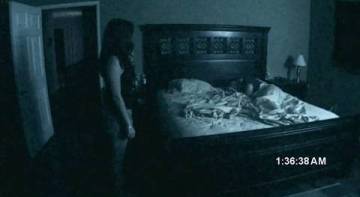 Much hype surrounded the release of Paranormal Activity, a film made in 2007. It attracted instant comparison with The Blair Witch Project in its use of the hand held camera technique and there are other more subtle similarities. But it is unfair to say that Paranormal Activity is a Blair Witch copycat. It’s a much better film, more disturbing and one that demands more than one viewing in a way that its predecessor never did. And whilst The Blair Witch Project was a scary film, Paranormal Activity is far scarier.
Katie and Micah are a fairly ordinary suburban couple. It’s the apparent ordinariness that makes this film so effective, particularly in the nondescript house where all of the film is set. Micah is intent on filming life at home. Some of this results in Blair style shaky handheld effects, whilst the rest of his footage comes from the hours of night vision photography taken in the bedroom. The double bed, the large white open door and the stop motion film as they toss and turn throughout the night. Why is he doing this? Katie believes she is being haunted, Micah believes he can solve the problem.
Director Oren Peli impresses in how the tension of this film very gradually cranks up. There’s one scene where a psychic, who appears at the beginning, is called again when things begin to turn bad. He senses the terrible atmosphere in the house and backs away, unable to help. It’s that sense of awful oppressive danger that comes across so well. Partly it’s to do with claustrophobia, the relatively tight setting of the film, but the build up is done so effectively. At first, the night footage reveals nothing more than noises coming from downstairs, although this in itself is disturbing and did cause me an ears-awake sleepless night after viewing this film. Perhaps one of our greatest fears is as simple as the concern about the creaks and unexplained movements we perceive going on around us during the night.
Peli works wonders with only a small set of tools. Most of the results are economically chilling. The noises downstairs. The bedroom door, seen to move on its own when Micah surveys a night’s footage. Katie’s sleepwalking, where she is revealed to stand in the same position for hours at a time. The experiment with talcum powder sprinkled on the landing, exposing far from human footprints. And so on. Like the psychic, the audience begin to sense the awful oppressive air in the house. Unlike him, they probably won’t want to leave it, bearing things out to their horrible end.
I came to Paranormal Activity fresh, not having read any reviews and knowing nothing of the plot. This is the way to approach it and I won’t give anything more away. Suffice to say that I was scared. A rarity. An unusual film indeed.
Previous Page |
Next Page
