28 Weeks Later is the much anticipated sequel to the 2002 film 28 Days Later. Danny Boyle’s original is very hard to follow, mainly due to the outstanding opening scene where the hero Jim (Cillian Murphy) wakes up in hospital and then proceeds to stagger through an eerily deserted London. Westminster Bridge with litter fluttering in the wind, an overturned bus or two. Countless post-9/11 photos plastered everywhere and pleas for the missing.
What’s going on? A rather nasty virus has taken just four weeks to turn everyone into crazed zombies who have learnt the neat trick of moving in fast motion. But don’t turn away just yet. We don’t see these movie monsters until the shots of an empty and silent city are fully milked. And brilliantly executed it is too. How did they manage to film this? How were thay allowed to? Getting up early on a Sunday morning I suppose, and there is the feeling of dawn breaking on a hopeless and bleak new day that comes across very well. New director Juan Carlos Fresnadillo and his crew must have risen really early as the deserted London theme is explored brilliantly in 28 Weeks Later. Tower Bridge, Docklands, The Gherkin are all revealed in their abandoned nakedness.
We get to see a lot more of a startling different and quite beautiful London. In this film, the area has been closed off to starve out the virus, American troops now patrolling nervously as the capital is slowly repopulated. Why isn’t London used more for film locations? I suppose because in the past it hasn’t been done very imaginatively, and I’m thinking of the red bus movies of the 1960s, where producers thought that a red bus appropriately positioned would get bums on seats. Red routemasters = swinging London. Films still continue to use red buses lazily. I loved Atonement, but there is appallingly unimaginative use of red buses to try to convey wartime in London. Come on, at least the bus has to be on its side to be worth including.
Perhaps it’s just too difficult and too costly to film in the smoke; it’s true that Bristol often serves for a more convenient stand-in for film and tv locations. But when it’s done well it can be breathtaking, and another of my favourite recent films is the dystopian gem Children of Men, which uses London to great effect.
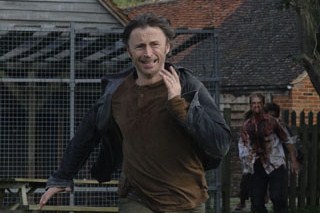
Buses aside, 28 Weeks Later doesn’t try to change anything that was good about the original. It uses the same excellent incidental music and the zombies still run in their fast motion style. As executive producer, Danny Boyle is clearly steering his original vision in new and interesting directions. A theme that’s introduced is that the virus has mutated; in rare cases people can become only carriers of the disease. Which unfortunately leads towards a rather unwelcome outbreak…
What was best about this film, and what made it surpass the original for me, was how it played on real human fears and weaknesses. Donald (Robert Carlysle) abandons his wife to the crazed zombies of the English countryside at the beginning of the film. There’s no question about this; he runs away and leaves her to die to save himself. He’s a coward. He has to live with his guilt and then has to lie to his children about what happened when they are reunited. He tells them that he saw their mother die, although in reality he didn’t hang around for long enough to find out. Standing up to the opening of the first film that I admire so much, it’s an attention grabbing and gripping start.
Carlysle, who you might expect to be the hero of the film, becomes something of a despicible character, and it’s his skill as an actor that makes it so believable. I still asked myself the question would I have run too? And this is what makes 28 Weeks Later a great movie. There’s real and very personal horrors that might catch up with us.
I doubt if it’s over yet though. As Fresnadillo is a Spanish gentleman, and as we get a glimpse of Paris right at the end, I suspect there will be a Euro flavoured film coming soon to complete the trilogy. 28 Months Later?
My heart began to pound in my chest, to pound so hard that it hurt. I hoped it could not see me, that, in a dark house, behind window glass, I was hidden.
The figure flickered and changed as it walked up the drive. One moment it was dark, bull-like, minotaurish, the next it was slim and female, and the next it was a cat itself, a scarred, huge gra-green wildcat, its face contorted with hate.
Where Fragile Things was about ghosts and faeries, the opening few stories of Neil Gaiman’s Smoke and Mirrors are more concerned with trickery and magic; the title refers to stage illusionists and their craft. Tarot cards are featured, as are magicians and their victims; Queen of Knives features the young Gaiman witnessing the very strange disappearance of his grandmother in a feat of stage wizardry. The later stories in the collection move towards a preoccupation with sexual encounters, and Gaiman also moves away from the supernatural to experiment with Raymond Carverish short pieces; brief, sometimes inconsequential, but often with the power to still disturb.
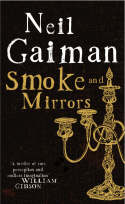
Then there’s Jonathan Ross. I knew that Neil Gaiman is a friend of the talk show host; they appeared together in Ross’s recent documentary about the Spiderman comic artist Steve Ditko and Ross’s wife has written the screenplay for the movie adaptation of Stardust. So it was no complete surprise to find the Ross couple featuring in a tale called The Facts in the Case of the Departure of Miss Finch. Here, the circus masquerading as a horror show receives the Gaiman treatment.
I’m not really a fan of Ross, so his presence in the story is just a little too sickly for me, and where I was slightly disappointed with Smoke and Mirrors was with the high humour quotient. This collection has more comic tales than the more recent Fragile Things. We Can Get Them You Wholesale, about what happens when you wish for just a little too much, didn’t do very much for me and neither did Chivalry, concerning a very unusual charity shop.
Gaiman features far more autobiographical stories in this collection. As well as the Jonathan Ross adventure, we hear a lot about his experiences in Hollywood, up against the madness there as he attempts to deliver sane film scripts. Very good is The Goldfish Pool and Other Stories, which finds Gaiman staying in the hotel where John Belushi died, befriending an ancient gardener and musing upon the film stars of the past. Oh yes, and fish. Highly recommended.
Although I was surprised to find a higher number of stories that didn’t gel with me than expected, Smoke and Mirrors still has its gems. It’s like crazy paving; wild and varied and another example of Neil Gaiman’s fevered and incomparable imagination. For me, I still like the straight ghost stories, something he can do with aplomb. The Price features Gaiman again, this time protected by a black cat who sits outside the family home and who is discovered horribly injured and mauled every morning. Removing the cat to the safety of the basement, the Gaiman family are suddenly beseiged by bad luck. Well again, the cat returns to the outside. The good luck returns, but once again the cat receives injuries. Then the writer decides to do some detective work… with worrying consequences. A really great story.
Also worth mentioning is The Wedding Present, which Gaiman wrote for some newlywed friends as a gift but decided not to give it to them. Fantastic, although I can understand why he held it back. And then there’s Troll Bridge, which is an outstanding and adult take on the Three Billy Goats Gruff fairy tale. Quite brilliant this one too.
Smoke and Mirrors has its hits and misses, but Neil Gaiman’s hits are always superb. The Price is one of the best short stories I’ve ever read. As a cat lover (and especially black ones), it’s the best cat story I’ve ever read. So worth a look.
That long-drawn, wavering howl has, for all its fearful resonance, some inherent sadness in it, as if the beasts would love to be less beastly if only they knew how and never cease to mourn their own condition.
Angela Carter is an author I’ve returned to after nearly two decades, deciding to read her collection of adult fairy tales as part of my quest for the perfect scary short story. Written in 1979, The Bloody Chamber seems defiantly anachronistic for those times. It’s still very modern, very current – and for a collection of fantastic stories – very real.

Angela Carter certainly knows her fairy tales. She can take the basic premise and mould it into something far more chilling than anything that would be allowed at a child’s bedside. The title story in this collection tells of a young girl on her wedding night and it involves the usual suspects of fairy tale motifs; badly lit castles and forbidden keys to locked rooms – with a blind piano tuner thrown in for good measure. Carter is good at plunging the reader back into this storybook world before reminding that her fiction exists in the real world too. A telephone will suddenly ring, the dreamlike interrupted by the very real.
The story titles are very suggestive – The Tiger’s Bride, The Snow Child and The Lady in the House of Love all suggest what they deliver. Most recognisable is The Company of Wolves, adapted so magnificently for the cinema by Neil Jordan in 1984. It’s a vivid, weird film – itself I think out of place in the decade it was made – but the original is far more suggestive, impressionistic and – oh yes – scary.
I’m still undecided about The Bloody Chamber. Maybe I’ll have to leave Angela Carter alone for another long spell. In some ways her fiction is too demanding, too strange and ultimately too inaccessible for my simple tastes. Read it though, let me know what you think – let me know what I’ve missed. Or maybe she’s just still out of time…
Previous Page |
Next Page
