On a Roll
Thursday November 29, 2007
in books | meme
From Booking Through Thursday.
Do you get on a roll when you read, so that one book leads to the next, which leads to the next, and so on and so on?
I always claim to stumble from book to book, although when I look back at the trail behind me I can usually spot a pattern.
I’m currently reading the latest novel by Clive Barker, which is probably because I’ve been reading a lot of Neil Gaiman recently, although I wasn’t really thinking of anything when I bought the Barker book. I just subconsciously decided to widen my appreciation of the ghostly and supernatural to include a taste of horror. And what probably got me onto this path was Nicola Barker’s Darkmans, which has a supernatural element and was nominated for the 2007 Booker Prize. Because I’d read both this and Ian McEwan’s latest, the Booker theme continued when I bought The Gathering by Anne Enright – the eventual winner. But I must confess that I hated the book, so sometimes rolls don’t work out.
Usually planned reading directions don’t work out for me either. I finished Albert Camus and wanted to read Kafka, but the plan went nowhere. I put Kafka away again for another day. Even when I find an author I love I can’t read too many of their books in one go; their power gets diluted. This year it’s happened with Cormac McCarthy, Graham Greene and Sebastian Faulks. Sometimes my roll goes no further than picking up the next unread book on my shelf, other times it’s picking up a tip from another blog. More often than not it’s just luck and chance.
My Weekend With Albert Camus
Wednesday November 21, 2007
in books read 2007 |
Mother died today. Or, maybe, yesterday; I can’t be sure. The telegram from the Home says: Your mother passed away. Funeral tomorrow. Deep sympathy. Which leaves the matter doubtful; it could have been yesterday.
And so begins The Outsider by Albert Camus. Meursault is a young man who is distanced from life; he has a girlfriend, Marie, and a career but remains uncommitted to either. When offered a promotion in Paris he frustrates his boss by failing to react enthusiastically. Similarly, he shows no positive reaction to Marie’s plans to get married and appears to simply drift through his life. It’s far from unpleasant, but he rarely shows that he enjoys it, and his lack of direction or commitment begins to show some worrying signs when he befriends a man called Raymond who rents an adjacent apartment. Raymond is a unsalubrious character who beats women and is pursued by shadowy criminals. He draws Meursault into his confidence who, showing his usual non-committance, is not particularly concerned where this new friendship will lead or the danger it may lead him into. Spending a weekend together with others, Meursault and Raymond run into the latter’s pursuers who attack him. Later, returning to the scene of the crime alone, Meursault shoots and kills one of them.
The Outsider is my first taste of Camus and it reminded me of Kafka, where you sink further into the text without realising it. It’s dense and layered, although at first only seeming the simplest of stories. Throughout the novel, Meursault describes the world around him through physical sensations; the heat on the day of his mother’s funeral; the pleasure from swimming in cool water; food and drink. He is baffled by the night long vigil beside his mother’s coffin; it’s the coffee and cigarettes that keep him awake. When he kills the man it is prompted by the glare of the sun in his eyes – an arguably physical reaction. Imprisoned and facing trial for murder, Meursault continues to show his usual lack of emotion. He describes prison life in great detail, but never complains about it. His only concern is satisfying his physical urges – sexual desire and addiction to tobacco. Marie continues to visit him and the visiting arrangements, with prisoners seperated from their families by huge metal grilles, sounds horrendous – although Meursault makes no complaint once he overcomes the physical barrier of managing to converse over the noise of the other prisoners. He gets used to things, however dismal his life becomes. When the trial commences, the prosecution appear more concerned with his lack of humanity to his late mother. Witnesses are called from her rest home and attendees from her funeral. Meursault’s character is torn apart, his coldness towards and abandonment of his mother more cruel in the eyes of those who judge him. They are less concerned with a cold blooded murder than exposing a cold blooded man.
One of the most memorable characters in the book is Salamano, another tenant in the block of apartments where Meursault resides. Salamano takes his dog out every day, cursing and reprimanding the elderly and sick animal. His foul tempered relationship with the dog becomes a source of amusement for Meursault, until the dog runs away and a heartbroken Salamano seeks consolation in him. It’s the only character in the novel who expresses longing and regret for something that’s happened, either from their own actions or those of others. And although Meursault offers him support, he doesn’t really understand, and when facing execution at the end of the novel he finally pours his energy into an outburst against the prison chaplain – a man who suggests he might like to turn towards God for some mutual support.
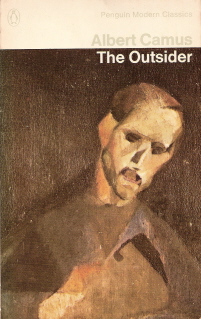
As well as its obvious debt to Kafka, The Outsider reminded me of the type of drama sometimes referred to as the theatre of the absurd; stark, weird but endlessly readable and open to interpretation. The cover above is from the Penguin Modern Classics 1971 edition (the novel was first written in 1942). Jacques Villon’s painting will haunt me as a vision of Meursault; fading, insignificant, condemned.
Noteworthy
Thursday November 15, 2007
in books | meme
From Booking Through Thursday.
How many of us write notes in our books. Are you a Footprint Leaver or a Preservationist?
I was once a Footprint Leaver in a big way, a lot to do with the fact that I studied for an English degree. I made so many pencil notes in margins and did so much underlining that I progressed to sticking post-it notes in pages. It was just quicker than making scribbles. My books would all have yellow pieces of paper sticking out of them, often more than one on a page. I grew out of the habit when I finished my degree, and going back to reread some of the classics I often puzzled over why exactly I’d left a yellow sticker in a particular page. I began to unpeel them all, one by one.
Starting to attempt writing book reviews, I was drawn back to my stickers and note taking but I’ve so far resisted. I’ve attempted and sometimes failed to commit the page numbers of important passages to memory. It can go disastrously wrong, and I recently forgot the part of an 800 page novel that I desperately wanted to refer to. I spent a wasted hour flicking through it to find the part I’d lost. But the reason I don’t like notes in books, especially those written in pen or when a highlighter has been given full flow, is when I find them in other people’s books. There’s nothing more disheartening than buying a second hand book, getting it home and opening it to discover the student vandalism that has gone on inside it. And nothing is worse than other people’s notes. And worse still is bad student notes, where the notes made are not noteworthy, the highlights highlight nothing and the passages marked yes! are definite nos.
So if you make notes in books and give them away, make sure they’re good ones. Or better still make them in pencil and rub them out when you have finished. Or just don’t make them at all.
Previous Page |
Next Page
