Books of the Year: Part One
Tuesday December 11, 2007
in books | reviews
The time has come again to trawl through the best books of the last twelve months. I’ve divided my choices into several categories. The first two cover new fiction.
Brand New
I’ve bought an alarming number of hardbacks this year. Reading books hot off the shelves is increasingly addictive. Right at the beginning of the year I enjoyed The Thirteenth Tale by Diane Setterfield. This is a novel I expected to receive more coverage. It’s very well written with some fine gothic undertones. Also recommended highly are two nominees for the 2007 Booker. Ian McEwan’s On Chesil Beach and Darkmans by Nicola Barker. We all know about the first, although the second is another book sitting in unfair obscurity. Worth picking up if you have the strength and stamina for its 800 plus pages. Incidentally, I found the eventual Booker winner, The Gathering by Anne Enright, tedious and unoriginal. What were the judges thinking of?
The best book of the year to grace my presence was The Road by Cormac McCarthy. It’s uncomfortable, harrowing, profound, frightening. It’s a masterpiece. Most importantly, it’s a book people will still be talking about in ten, twenty years time.
Lastly in this section, if you do have any Christmas money left over, I’d suggest Engleby by Sebastian Faulks. Quite different to anything else he’s written and very, very good.
Nearly New
My pile of newly released paperbacks of 2007 has reached toppling height, although there are only a few I would recommend highly. Again, some of them are criminally obscure. The Testament of Gideon Mack by James Robertson is an unsettling yet gripping book about a man who may or may not have met The Devil. Fantastic.
Less obscure is The Tenderness of Wolves by Stef Penney, a novel that’s received divided responses, at least going by the comments I received for my review. But I found it an absorbing and original read. However, my favourite paperback of the year by far was Neil Gaiman’s Fragile Things. This is a collection of supernatural stories that is well written, wry, highly original and, most importantly, scary.
Sadly, it was the books that received too much attention that disappointed the most. Don de Lillo’s Falling Man, Jed Rubenfeld’s The Interpretation of Murder and, I’m sorry to say, the final Harry Potter took up too much reading time that that would have been better spent on something more worthwhile. Here’s to 2008.
Ha! That disgusted you a little, didn’t it? I caught that little flicker of revulsion on your face. Now you’re trying to cover it up, but you don’t fool me with that oh-so-confident look, as though you knew every secret under Heaven.
In the 1990s, Clive Barker’s Hellraiser films became something of an obsession with me and the guy I shared a flat with at the time. The first 1987 film is one of my horror favourites, and I’ve recently read with some interest that Barker is currently working on a remake, no doubt utilising the developments in CGI to make his creations more horrific, although the most chilling aspect of the films was Doug Bradley’s performance as Pinhead. More disturbing, the actor is now currently reduced to advertising something on the back of buses in my home town, his huge head often ahead of me in the traffic. But sadly minus the pins.
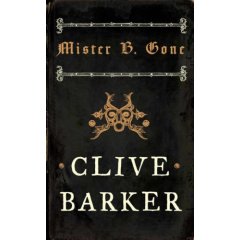
So although he’s always sat somewhere in the back of my mind, it’s taken me ten years to start showing an interest in anything new by Barker. His latest novel, Mister B. Gone, follows the exploits of a particularly loathsome demon in 15th Century England, a backdrop that reminded me at times of Ken Russell’s film The Devils. Human depravity, torture and execution, the actions of mortal man put anything demonic firmly into context. The novel is narrated by Jakabok Botch, mysteriously imprisoned in the pages of the book that he constantly demands that the reader burn. But of course the reader reads on.
Barker’s premise is preposterous, but it is a tribute to his skill as a writer that he manages to just about pull it off. His prose is mostly excellent and so is his skill as a narrator, so no matter how incredible the story becomes Jakabok, rather than enticing you to burn the book, entices you to read on. But be warned; Mister B. Gone does contain some sickening passages of pure unadulterated horror. Although anyone familiar with Barker’s books or films will not be surprised. Or disappointed.
Clive Barker has many similarities with Neil Gaiman in how he uses the foundation that the supernatural world exists in tandem with our own; this is a fact that the reader must accept before they can appreciate how both writers can make the two worlds coexist. You just have to adjust to this seamless integration to appreciate both of these authors. Where Gaiman plunders fairytales and familiar sounding ghost stories to rework in his original style, and often bring them into the modern world, Barker uses the recognisable presence of Hell and The Devil and turns it loose on early society, one that firmly believed in the presence of the demonic, to work his wonders. It’s a conceit that works far better than I would have predicted, with Barker creating a compelling narrator who uses the age old trick of suddenly reminding the reader that they are enjoying something quite horrifying. The novel is peppered with many nudges to the reader similar in flavour to my opening quote.
I was glad when I finished Mister B. Gone, but I didn’t want to burn it. But I also don’t think Clive Barker is really my cup of tea any more; perhaps I won’t find Hellraiser films entertaining any more either… he does what he does very well – but ultimately you have to decide whether or not you need or will appreciate fully what he provides.
Funtime Memetime
Monday December 3, 2007
in meme |
This time last year a popular meme did the rounds. I liked it so much I’m doing it again. To take part, just quote the first sentence from your first post for every month of the last year. Here’s mine. They say time goes quicker as you grow older; I say it goes quicker still when you blog.
January
Jakob Nielsen has been delivering articles to my inbox for some time now.
February
Stone circles, strange cults, mankind in danger and an alien menace.
March
Steerpike was aware, directly he had entered the terrible room, that he was behaving strangely.
April
After dealing with travel sickness and a neighbour’s over concern about the height of my lawn, I am now back online.
May
My posts are becoming increasingly serious lately so a meme to lighten things up.
June
After looking forward so much to reading Don De Lillo’s Falling Man I’m unable to hide my bitter disappointment in the novel.
July
You may be familiar with my recent frustration on discovering that Microsoft Vista is incompatible with my beloved home wireless network.
August
In Life Class Pat Barker revisits the setting of the First World War, the ugly moment in history she so excellently helped to document in her Regeneration trilogy written ten or so years ago.
September
I’ve been a latecomer to the fiction of Irvine Welsh.
October
The air is crisp and there is a definite chill in my bones.
November
That long-drawn, wavering howl has, for all its fearful resonance, some inherent sadness in it, as if the beasts would love to be less beastly if only they knew how and never cease to mourn their own condition.
December
This is a segment from the 1972 film Tales from the Crypt, featuring Joan Collins as a murderous housewife who gets her just desserts.
Previous Page |
Next Page
