If on a Summer's Holiday a Blogger
I’ve become so accustomed to not reading that I don’t even read what appears before my eyes. It’s not easy; they teach us to read as children, and for the rest of our lives we remain the slaves of all the written stuff they fling in front of us. I may have had to make some effort myself, at first, to learn not to read, but now it comes quite naturally to me. The secret is not refusing to look at the written words. On the contrary, you must look at them, intensely, until they disappear.
You are on a few days holiday break in Italy. You have taken along a copy of If on a Winer’s Night a Traveller by Italo Calvino. You think it will be fitting to read a classic of modern Italian literature. Furthermore, you decide to write a post in the style of Calvino once you get home. You like the conceit of the book, reading it as you queue to enter tourist attractions, and when your family spend time looking in the shops selling carnival masks. You like the way the text plays with the reader, reminding them that they are reading a novel and constantly tantalising you with new and unfinished stories…
But when I got home I decided not to write a post in the style of If on a Winter’s Night a Traveller by Italo Calvino. Eventually the book gnawed at my patience for too long. Written in 1979, Calvino’s novel is composed of a collection of openings to novels. The reader (you) stumbles from one unfinished text to another, witnessing (and reading) a detective story, a murder and several meditations on the relationship between text and reader. This is a book that fans of literary theory will get very excited about, and it’s a book that David Mitchell also got very excited about (proving the inspiration and the structure for Cloud Atlas). The problem may be me; I have a short fuse with this sort of thing. Films-within-films, plays that remind you that you are the audience, books that remind you that you are reading them. So forgive me for endulging in a post that reminds you that you are reading it (that is, of course, if you’ve bothered to get this far).

You are getting to the end of your post. You realise that you don’t have much to say about If on a Winter’s Night a Traveller by Italo Calvino. You are thinking more about the other book you read on your few days holiday in Italy. You begin to shape some thoughts on your next post…
For some time now I’ve had a mental block when it’s come to Graham Greene’s The End of the Affair. No doubt this is due to the image of Ralph Fiennes’ heaving buttocks from the most recent film adaptation, which unfortunately come to mind whenever I think of the novel. But what Mr Fiennes has done is plant the suggestion of seediness in my mind, and Greene’s novel, both his depiction of London during and after the war, and Bendrix and his snatched affair with Sarah and all that follows really does read as a seedy business.
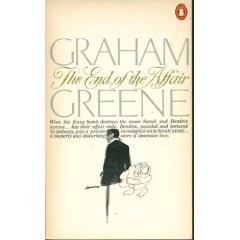
Bendrix narrates the novel, a writer by trade who can well articulate his own shortcomings as a human being. He’s aware of his own bitterness and hatred, but Greene also reveals one of the most arrogant voices I’ve read in a long time. He perches himself far above many of the people he encounters, whether it’s the humble private detective or the betrayed husband Henry. All inhabit a late 1940s world of bombsites, dark bars and darker weather; a setting that’s breathtakingly realistic. But this isn’t why I found the book seedy; it was more the people in it, and all but one of the characters I disliked. In fact the only one I was ambivalent towards, the young girl who Bendrix picks up and takes to Sarah’s funeral, is one of the few that has a lucky escape from him. Of those that suffer, particularly Henry, I tended to share the contempt that Bendrix has for them.
Like many of Greene’s other novels, the subject of Catholicism rears its head. Here, Greene treats Belief and God as something that can be caught, an infection, and just as Sarah contracts pneumonia from the dank London streets, Bendrix fears that he, too, will ultimately believe in God but it will be little more than an unwanted infection. Throughout the book there are also odd glimpses of the supernatural; a skin disease apparently healed by Faith, Sarah’s deal with God that she will not see Bendrix after she thinks he has died in an air raid.
For such a brief piece at 160 pages, The End of the Affair is incredibly dense. It drained me as a reader, and Greene continues to prove that less is more, and that the lesser writer would fail in the temptation to drag out the affair even more. But it’s a painful book to read.
Inspired by Simon’s post I’ve been giving some thought to my holiday reading this year. As I’m currently restraining myself from buying anything new I’m going to find it difficult to pass the airport exclusive stands. Like a smuggler who tries to pass through customs as quickly as possible on the way in to Heathrow, I’ll be dashing past Waterstone’s with my head down on the way out. But I’m determined to keep plundering my existing stock of books.
I’m currently halfway through Cormac McCarthy’s The Crossing. It’s taking me so long to read that I’ll probably be taking it away with me in a couple of weeks time. And if I can stomach any more McCarthy I might also pack Cities of the Plain, the final part of his Border trilogy. Although experience has taught me that it’s wise to leave long periods of rest between McCarthy novels.
This weekend it’s the annual harbour festival in Bristol. Finding the heat and crowds overwhelming yesterday, I excused myself for an hour to find a quiet and shady tree to read by. I noticed only one other reader in my field of vision, a young lady halfway through The God of Small Things. So a chance inspiration for my next title.
The other books will possibly be a choice between The Bone People by Keri Hulme, something else by Joseph Conrad or Graham Greene (often good for holidays). Or I may allow my wife to buy an airport exclusive for me. Which isn’t really cheating.
Previous Page |
Next Page
