‘Lady Fuchsia! May I join you?’
Behind him she saw something which by contrast with the alien, incalculable figure before her, was close and real. It was something which she understood, something which she could never do without, for it seemed as though it were her own self, her own body, at which she gazed and which lay so intimately upon the skyline. Gormenghast. The long, notched outline of her home. It was now his background. It was a screen of walls and towers pocked with windows. He stood against it, an intruder, imposing himself so vividly, so solidly, against her world, his head overtopping the loftiest of its towers.
Greed, ambition, the desire for self-advancement. Ultimately, evil. In Titus Groan, Steerpike appears to Lady Fuchsia to be larger than the vast castle of Gormenghast, overpowering it and engulfing it, his ambition manifest.
A mere worker in the castle’s kitchen, Steerpike has wormed his way up through the ranks of Gormenghast. Escaping from the sinister servant Flay, he literally climbs his way up to more satisfying heights of the castle and finds himself in Fuchsia’s beloved attic by scaling the ivy growing against a wall. A vertical drop of several hundred feet doesn’t sway him. From there he befriends the eccentric Doctor Prunesquallor, through him the weird twin sisters of Lord Groan himself. And then he hatches his devilish and Machiavellian plot…
Titus Groan isn’t the fantastic tale I’d anticipated. Greed, ambition, self-advancement. We see it every day.
Well I’ve started Titus Groan by Mervyn Peake. I’m excited by the fact that I really know next to nothing about this book, or the rest of the Gormenghast trilogy. I’m only a few chapters in, but I’m loving it already. In my edition’s introduction, Anthony Burgess describes the writing style as harking back rather than being progressive, and if I understand what he’s getting at I would liken Peake’s style to Dickens. He’s certainly one for describing grotesque and eccentric characters, and Lady Groan comes across as a distant relation of Miss Havisham:
She was propped against several pillows and a black shawl was draped around her shoulders. Her hair, a very dark red colour of great lustre, appeared to have been left suddenly while being woven into a knotted structure on the top of her head. Thick coils fell about her shoulders, or clustered upon the pillows like burning snakes.
And in the context of the weird castle of Groan, she really doesn’t appear strange at all…
Here’s a helping of the gothic, the fantastic and the downright scary. At the Mountains of Madness by H.P. Lovecraft is the story of a particularly disastrous expedition to Antarctica. One group of explorers meet a very gruesome end, whilst a second make some very disturbing discoveries.
It certainly is an effectively chilling story. For me, the opening chapters work the best in how they hint at the horror in the frozen wasteland. Think of having to describe John Carpenter’s film The Thing, but not being allowed to go into gory detail, in fact only being allowed to vaguely suggest what has happened to the alien’s victims. Lovecraft cleverly hints at the impending fate of the explorers; their isolation, the nervousness of their dogs, the very vastness of the unwelcoming landscape:
In the whole spectacle there was a persistent, pervasive hint of stupendous secrecy and potential revelation. It was as if these stark, nightmare spires marked the pylons of a frightful gateway into forbidden spheres of dream, and complex gulfs of remote time, space and ultradimensionality. I could not help feeling that there were evil things – mountains of madness whose farther slopes looked out over some accurse ultimate abyss.
At the Mountains of Madness was rejected by the magazine Weird Tales when it was written in 1931. It’s difficult to see why, as weird it certainly is. But conventional, at least for the time, it isn’t. Whilst the opening chapters sit comfortably in the horror/science fiction genre, the later ones veer off into gothic territory when a second group of explorers unwisely decide to look further. Lovecraft paints a very detailed picture of a vast, ancient and seemingly abandoned city; his description is so vivid that I felt I was walking through its claustrophobic caverns. Creepy and disturbing, but not quick-fix horror.
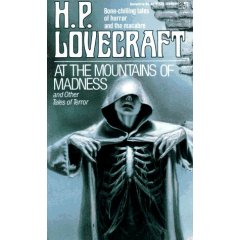
If you haven’t been scared off by the cover art above, it’s from a 1991 edition of the book – described by Amazon as a mass market paperback. You couldn’t find more of a contrast with the cover of a different edition, below, which has more of a connection with the story, showing the foolish explorers travelling into Antarctica by air.
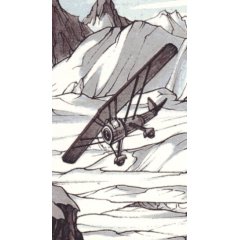
The first cover suggests the quick-fix horror, the second more a Boy’s Own adventure about to go wrong, or a 1930s update of an H. Rider Haggard adventure. A sort of King Solomon’s Mines where no one gets out alive – or sane.
Previous Page |
Next Page
