Our room looked over roofs down to where this funny quay crooks into the sea. Gulls dived and screamed like Spitfires and Messerschmitts. Over the English Channel the sticky afternoon was as turquoise as Head and Shoulders shampoo.
‘Ah, you’ll have a whale of a time!’ Dad hummed a bendy version of ‘I Do Like to Be Beside the Seaside’. (The bathroom door’d opened by itself, so I could see Dad’s chest reflected in the mirror as he put on a string vest and the shirt he’d just ironed. Dad’s chest’s as hairy as a cress experiment.) ‘Wish I could be thirteen again.’
Then, I thought, you’ve obviously forgotten what it’s like.
David Mitchell is a writer who has the ability to assume any number of believable and different voices. He proved this in Cloud Atlas, with its array of six seperate narrators that shifts from the 19th Century to a distant and dystopian future. Black Swan Green is far less ambitious with Mitchell adopting one voice for the entire novel, that of a thirteen year old boy.
Jason Taylor lives in Black Swan Green in Worcestershire. It’s 1982. Adolescence and early Eighties Britain is seen through his imaginative eyes; girls, school, friendships and family life. Mitchell scatters references to appropriate television shows and news from the period (the Falklands War casts a large shadow) throughout the novel. Taylor appears a bright lad, he’s recently won a poetry competition. There are, however, things playing on his mind; he suffers from a stammer (referred to throughout the book as Hangman), and he’s constantly conscious of the fragile pecking order that exists in his peer group.
The threat of madness and death looms heavily in Black Swan Green. In one chapter, Jason and his friend stumble across a summer party at a country asylum that is disturbingly cut short, and he has several encounters with other unhinged and potentially dangerous characters. These are usually eccentrics living on the fringes of his comfortable surroundings, such as the larger than life Madame Crommelynck or the band of gypsies he befriends. Jason also constantly refers to children in his school who haven’t quite made the grade when it comes to intelligence, and adulthood is often viewed as a sad, lonely and unfulfilled as personified by parents, neighbours and teachers.
A novel from the point of view of a young male invites comparisons with other recent fiction, particularly The Curious Incident of the Dog in the Night Time by Mark Haddon and Vernon God Little by DBC Pierre. I’m sure there are countless others that I haven’t read in a trail that goes right back to J.D.Salinger. Black Swan Green also reminded me of Bad Behaviour by William Sutcliffe in how peer pressure means everything to a thirteen year old and how the balance can easily change. Mitchell describes each boy’s status as being similar to army ranks, and Jason slips down to the very bottom as the novel progresses.
My disappointment with Black Swan Green came from my expectations of David Mitchell. Cloud Atlas was such a strange and original novel that I was expecting something similar, and the opening chapter of Black Swan Green is fantastic, describing a lake where many children have died in the past where Jason and his friends play on its frozen surface, the menacing phone calls that his parents are receiving and a very odd encounter at a house in the woods. The novel just doesn’t follow this promise and is more content to settle into more familiar territory with everything interesting, the threats of madness and death, only remaining under the surface. It’s not that I expect every novel I pick up to be dark and disturbing, but I do expect this if the opening chapter suggests so, and where there are many references to accidental deaths haunting the book. Ultimately, Black Swan Green reminded me the most of another book set in 1982 and narrated by a thirteen year old boy, The Secret Diary of Adrian Mole. This isn’t a criticism, it’s just not what I expected.
Bullet Points and Winter Warmers
Friday January 12, 2007
in books |
- Patrick McCabe’s Winterwood left me sitting in a stunned silence. Stunned because I didn’t really know what to make of it; the book is well written, dark and very disturbing but I’m not sure what it’s done to me. If anything. It’s still slowly sinking in.
- Possibly because McCabe had left me sitting in a trance, I left it too late to vote in the Seventh Annual Weblog Awards. A shame, because there’s a good few blogs that I’d have voted for.
- To get my strength back I’ve started reading Black Swan Green by David Mitchell. I’m racing through it and will probably feel suitably rejuvenated to give a full review soon.
- Goldfinger by Ian Fleming is proving an easy but enjoyable read. I’d describe this type of book at this time of year as a winter warmer. Bond is portrayed as the killing machine who will ruthlessly dispense with someone who gets in his way. With his bare hands – The original Bond I’ve often heard about. It’s funny, but as I’m reading I don’t think Sean Connery but I think Daniel Craig.
- As I always welcome a complete contrast, I’m enjoying reading the Horrid Henry stories with my daughter. Francesca Simon’s a very witty writer, and Tony Ross is one of the best illustrators around. Contrasts, you can’t beat ‘em.
Another recent television adaptation has had me rifling through piles of old paperbacks to find the original. This was the BBC’s slick new version of John Wyndham’s short story Random Quest starring Samuel West.
Following an accident during an experiment, a scientist wakes up to find his familiar world a little different. The most startling surprise for him is that he is now a successful author and married to a girl he has never met before called Ottilie. Eventually returned to his own world, he sets about finding his new wife. Even though she appears not to exist in his universe, this doesn’t put him off…
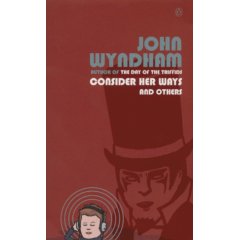
I eventually found my book of John Wyndham short stories called Consider Her Ways and Others, first published in 1961. Random Quest is set in 1954, and the differences that Colin Trafford notices between the two worlds are somewhat quaint:
I added soda to the brandy, and took a welcome drink. It was as I was putting the glass down that I caught sight of myself in the mirror behind the bar….
I used to have a moustache. I came out of the Army with it, but decided to jettison it when I went up to Cambridge. But there it was – a little less luxuriant, perhaps, but resurrected. I put my hand up and felt it. There was no illusion, and it was genuine, too. At almost the same moment I noticed my suit. Now, I used to have a suit pretty much like that, years ago. …
I had a swimming sensation, took another drink of the brandy, and felt, a little unsteadily, for a cigarette. The packet I pulled out of my pocket was unfamiliar – have you ever heard of Player’s ‘Mariner’ cigarettes – No? Neither had I.
In the 2006 version, unexpected military moustaches, Army life, smart suits and cigarettes are all jettisoned. What’s different here is the gleaming white space age apartment and attempts to be futuristic on a low budget. Trafford’s party guests stand around looking like extras from Space 1999. Where the 50s Trafford reads about the new universe in copies of The New Statesman to discover that the Second World War hasn’t taken place, the 21st Centrury Trafford watches BBC News 24 to realise there has been no fall of the Berlin Wall. Condoleeza Rice and Tony Blair receive appropriate namechecks. There’s nothing like a modern pesrpective to sketch out your alternative universe.
What’s striking about Random Quest the short story is what’s ultimately odd about the new television version. Parallel universes are old hat in 2006, but Wyndham’s story must have come across as a very fresh and original premise in 1961. One of the conceits of the new BBC film is that our hero, momentarily trapped in the parallel world as the sci-fi author version of himself, proposes a new book about a scientist – you’ve guessed it – who is catapulted into a parallel universe. Everyone thinks this is a very original idea for a book. In fact, nobody has thought about parallel universes in this world, but perhaps this is an alternative Earth that’s missing Star Trek, Doctor Who, Sliding Doors and countless other film and television science fiction. And, most importantly, what possibly influenced all of the above – John Wyndham.
Footnote: The new version was a disappointment, although Random Quest was previously filmed in 1971 as Quest for Love with Tom Bell and Joan Collins. I haven’t seen this film for years, but putting the seventies production standards aside, I’d imagine it’s still a very enjoyable film.
Previous Page |
Next Page
