there was a war on: you could tell that too from the untidy gaps between the Bloomsbury houses – a flat fireplace half-way up a wall, like the painted fireplace in a cheap dolls’ house, and lots of mirrors and green wall-papers, and from round a corner of the sunny afternoon the sound of glass being swept up, like the lazy noise of the sea on a shingle beach.
This extract from the opening of Graham Greene’s The Ministry of Fear sets the mood for the novel perfectly; the imagery of the dolls’ house prepares for the surreal atmosphere of the book, as does the use of mirrors and eerily familiar interiors for the nightmare world of Arthur Rowe. The numbed familiarity of the London Blitz is also brought to the fore; writing in 1943, Greene brilliantly sketches the backdrop of a capital at war – strong enough for a modern reader to taste the sound, smell and fear of the bombings.
The Ministry of Fear is one of Greene’s oddest books, and reads at times like his usual prose has been soaked in Kafka and Conrad. The brilliant opening chapter finds Rowe at a sorry wartime fête, where he correctly guesses the weight of a cake on the advice of a fortune teller. Here’s starts Greene’s own nightmarish take on the wrong man story, with Rowe pursued by dark forces across a London under threat of the air raid. It’s a brilliant tale, illuminated by the panic and uncertainly of 40s London. As usual, Greene can say a lot in few words; whilst the novel is brief it is also dense and layered, proving again that he is not always the easy author we take him to be.
Unfortunately this novel doesn’t live up to its early promise. Perhaps I was more interested in the background of the Blitz rather than the plot, which attempts to unravel the weird set pieces, which include a murder at a séance, an encounter with a seedy bookseller and a spell in a sinister hospital, to explain itself more logically. This somehow takes the fun out of things, but The Ministry of Fear is worth a read for an example of good literature that just doesn’t age.
It’s official. The beauty of Neil Gaiman’s imagination has at last been realised in Coraline. The film is visually stunning, witty and most of all strangely moving; I haven’t enjoyed a film for children this much in a long time.
What worried me was that the young audience I was part of were not so appreciative. This isn’t a film for the very young, and maybe not even for the impatient adult (as I left the cinema I overheard a child asking her mother what long winded meant). Although only 100 minutes in length Coraline did appear as quite long (I think animated films are just more exhausting), and the ten year old film critic that accompanied me appeared oddly deflated. Perhaps it was the element of scare in the movie. Perhaps I had built it up too much. Perhaps Neil Gaiman is a matter of acquired taste.
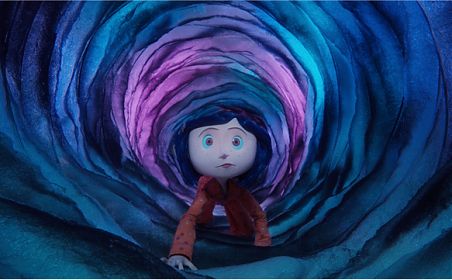
But I loved it. Coraline is visually breathtaking, perhaps the best animated film I have ever seen. It isn’t just the level of technology; I found the effects weren’t just there to be showy and always complimented the story perfectly. Because Coraline is essentially a fairy tale, there’s a fairy tale logic to everything that happens. It’s very tight, and for all my scrutiny I could find no holes in the plot. Director Henry Selick (responsible for the vaguely similar James and the Giant Peach) does a very accomplished job. Probably both in 2D and 3D – the 3D version of the film we saw today doesn’t, I suspect, add too much. It’s just a great experience without the extra bells and whistles.
Those familiar with Gaiman’s work will already know the story of Coraline. A girl who briefly escapes her dull new home, where her parents spend most of their waking hours with their backs turned, to visit a half dreamlike alternative world where her mum and dad appear exciting and, most importantly, interested in her. Appear is the key world here, as the people in this “other” world have buttons for eyes. Something isn’t quite right because, quite rightly, buttons for eyes are the stuff of nightmares.
So unfolds the brilliant fairy tale. The animation realises it superbly, from button shadows covering the moon, to performing mice, a very wise cat and an eerie tunnel between the two worlds (pictured) that brought back the worst memories of Hellraiser from the corners of my memory. Best of all is how Coraline slowly realises that horror is around her and that she must act. Dakota Fanning (from Charlotte’s Web) is fantastic in the role, totally believable throughout. As I’ve said, it’s also moving; especially the scene when Coraline loses her real mum and dad and creates her own pair of button parents to prop beside her in the empty double bed.
The rest of the cast are also wonderful. Teri Hatcher is very impressive as both of Coraline’s mothers, Ian McShane plays an eccentric neighbour and Dawn French and Jennifer Saunders turn up as two rather odd sisters to provide some humour. Unlike many animated films, however, Coraline never knowingly assumes it can go over young heads, although the trade off I suspect is the very young, who just aren’t ready yet for this sort of sophistication. Unwittingly, this film may be just too advanced for much of its intended audience.
My pals on Twitter will already know that I’ve given this a nine out of ten. I’m sticking with that, but I feel that there was so much in this film that I need to see it again. It’s so lovingly made, and that’s a rarity these days in children’s cinema. This is quality, real quality. So hats off to this film, and even a bow; the best film I’ve seen this year.
But sometimes, in the street, without thinking, with a natural gesture, she took my arm, and then, yes, I surprised myself by missing the other life that could have been, if something hadn’t been broken so early. It wasn’t just the question of my sister; it was vaster than that, it was the entire course of events, the wretchedness of the body and of desire, the decisions you make and on which you can’t go back, the very meaning you choose to give this thing that’s called, perhaps wrongly, your life.
Jonathan Littell’s The Kindly Ones is extraordinary; a detailed and sweeping account of the Second World War that is extremely well researched, intelligent and well written. It may be a classic, and it demands serious attention, but I am still to decide how much I liked this novel. At 975 pages this is a very difficult and demanding read; it is at times turgid, infuriating and meandering, whilst at others there is a genius in Littell’s writing that does shine through, albeit fleetingly.
Please note that as I attempt to make sense of this book, the following will contain spoilers.
The novel is narrated by Max Lau, an SS officer who, although open about his role in the massacres of the Holocaust, does often take the role of an observer of the atrocities of the Third Reich. Lau reveals that he escaped to France after the war by assuming a new identity and surviving to old age. The Kindly Ones is his memoir, which although ostensibly a part fictional part historical account of the Second World War, also features the dark undercurrents of incest and matricide.
The novel is divided into seven chapters; Toccata, Allemande I and II, Courante, Sarabande, Menuet en Rondeaux, Air and Gigue. Apparently this refers to the sequence of a Bach suite, although I had to look up the reference. Furthermore, each chapter is supposedly based on the style of each dance although, again, I did miss this allusion. Jonathan Littell has the tendency to be pretentious, although can overcome this with his talent as a writer.
The Kindly Ones is harrowing from the start, with Lau recounting his involvement in the horrendous massacre of Jews and Bolsheviks in the Ukraine. Although, as I’ve said, he’s more of an observer than a participant, Lau does appear to show a cold detachment to what is going on around him. His role on the sidelines make the terrible events all the more difficult to take. How could he stand by and let so much go on? Which is, of course, the rub. Nevertheless, the harrowing events do begin to play on his physical and mental faculties. Lau’s narrative also reveals his attraction to homosexuality and also to incest. We learn that Lau’s father mysteriously disappeared, his estranged mother remarried and that Max has a twin sister; one he is obsessed with.
Events move on to the battle of Stalingrad, which Lau manages to escape before the German defeat after being seriously wounded. Although shot in the head, he makes a miraculous recovery. His friend, Thomas, also suffers serious injuries but pulls through. After recovering in Berlin, Lau is awarded the Iron Cross by Heinrich Himmler. He decides to reacquaint himself with his mother and stepfather and in one of the novel’s strangest sequences, his mother and her husband are brutally and mysteriously murdered. On discovering the murder scene, Lau flees.
Lau is promoted to an advisory role in the management of concentration camps, here attempting to do some – although ultimately flawed – good, in trying to improve the hopeless conditions for the inmates. He is also dogged by two detectives who suspect him of the murder of his mother and stepfather. Although the case is eventually dropped (now in a senior role, Lau has many useful contacts), they continue to periodically surface to harass him. We also learn that his mother was in charge of two mysterious twins, whose parentage is unknown but who have fallen into the care of his sister. Around this time Lau considers a relationship with a young woman and tries to court convention, although he later decides to forget her.
The Kindly Ones reaches it darkest section with Lau visiting the empty home of his sister and indulging in lurid sexual fantasies. His one man orgy becomes a sequence of dreams merged with reality. Although deeply disturbing, Littell really reveals his brilliance here. The term nazi porn has been directed at the book, most probably with reference to this chapter. Although there is an element of dark pornography here, I still herald Littell’s writing. I can’t explain or defend this contradiction, but I will always be honest about what I think is talented writing.
Thomas eventually arrives to rescue Lau from his self indulgent breakdown, and they travel to Berlin as the war draws to its end; on route they meet a group of murderous children. We reach Berlin and Adolf Hitler makes a small but memorable appearance in the story. In an almost surreal scene, Lau attacks the Führer and assaults him, but whilst under arrest manages to escape in the chaos of Berlin falling. He is confronted by one of the detectives obsessed with the murder case (who, we presume, has been obsessively following him), although Thomas intervenes and kills the aggressor. The novel ends with Lau then coldly killing Thomas, thus stealing his identity (Thomas – perhaps foolishly – earlier revealing that he had a cunningly invented French persona as a line of escape) which enables Lau to flee to France to start a new life.
Littell throws many riddles at the reader that are left unsolved. Although the circumstances of his mother’s murder are never explored, I drew the conclusion that Lau killed her, especially as the original French title Les Bienveillantes relates to The Oresteia written by Aeschylus, which featured the vengeful Furies who tracked down those who murdered a parent. In Lau’s case, however, he makes a clean break. I’m also guessing that the enigmatic twins who feature in the story are the offspring of Lau and his sister; the twins of twins – an echo of duality running through the book, the duality of good and evil that Lau wrestles with before always succumbing to the latter.
The Kindly Ones has been descibed as having a “terrible twist”. This is misleading, suggesting something unexpected and surprising. That Lau kills Thomas is, sadly, not a surprise. He saves his own skin, giving in to his ultimate act of evil. Thomas gives him the germ of an idea. With it, he thrives. If you want to be really crude, it’s the survival of the fittest. But it is true that this is truly terrible.
The precisely written prose of The Kindly Ones is both a blessing and a hindrance. Littell’s narrative is so detailed that it provides an absorbing account of Lau’s world, which at times becomes so fascinating and real that you begin to doubt that he can really be a work of fiction. At the same time, the book grinds almost to a halt when it becomes preoccupied with nazi ideology, sometimes recounting detailed conversations that run over dozens of pages. And when the novel gets odd it really gets odd, at times uncomfortably so, but some of the sections – especially the account of the fall of Berlin at the end of the book – are beautifully written.
The Kindly Ones was rewarded with the attention that it ruthlessly demanded from me. But it wasn’t easy. It’s an absorbing book, but also an infuriating one. At times depressing, and rarely uplifiting, but one revealing talent in the author, and one stretching the reader. In my case, almost to the limit – the most demanding book I’ve ever read. But I’ve never said that good literature shouldn’t be difficult. If you are a real reader – and I think you are – there’s no option but to try this.
