Mister Pip and the Breakthrough
Thursday January 24, 2008
in books |
Do you bother reading the blurb on the inside cover of paperbacks? I certainly wouldn’t buy a book on the strength of them, and I rarely read them on the books I do buy. And when I do read them I tend to read only the lengthy ones – a paragraph or two on the virtues of the book rather than the quick great read or magnificent book.
I’m currently reading the paperback copy of Mister Pip by Lloyd Jones. It features more than the average amount of snippets from rave reviews. No problem for me, I think it’s a great read so far – it might even be a magnificent book. What I did notice for the first time was that the snippets included a quote from a book blog. This is the first time I’ve ever noticed this on a UK paperback. Is it a first?
Alas, it’s not a great quote, but it’s a great start. One of the reasons I rarely read paperback blurb is because it always comes from newspapers and magazines that give their reviewers free copies of the latest releases and then, shockingly, pay them to write reviews. Unless I’ve got this all horribly wrong, I understand that the majority of book bloggers don’t receive their books for free and certainly don’t get paid for their reviews. In most cases they’ll be out of pocket, buying a book and sharing their thoughts for free. Call me romantic, but somehow this makes me more interested in what they have to say. So here’s to more quotes from blogs on the inside covers of paperbacks. More of us might even read them.
4 Stars
Written in 1954, Richard Matheson’s I Am Legend was first filmed as The Omega Man in 1971. It starred Charlton Heston, a reasonable choice for the lead coming only a few years after his success in the post apocalyptic Planet of the Apes. In the early 1990s a new version was touted starring Arnold Schwarzenegger. Again, not surprising when you looked at his CV, although this film was, perhaps thankfullly, never made. I Am Legend has eventually returned to the cinema starring Will Smith. Not my first choice (Nicolas Cage springs to mind for such a role, even Daniel Craig), although I’ll refrain from commenting further until I’ve seen the film.
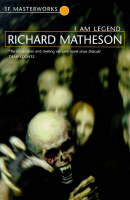
In the great family tree of horror and sci-fi, it’s not difficult to trace countless books and films back to I Am Legend. Matheson’s future not only concerns an empty city after a deadly plague has killed off most of the population, but also features some of the (un)lucky survivors now doing their night to night business as vampires. Translate vampire into zombie and you have the blueprint for Night of the Living Dead, Dawn of the Dead, 28 Days Later and many others. But a blueprint doesn’t necessarily make a good novel, so is I Am Legend any good? Well I wouldn’t go as far as to say it was great literature but it is a very, very good book indeed…
Robert Neville lives alone in his customised home; he can generate his own electricity to keep his stock of frozen food fresh. He spends his hours making tools, especially wooden stakes. Time is something he has a lot of because, more or less, he’s the last man on Earth. Occasionally Robert Neville drinks. He drinks a lot, but we can forgive him for that as every night a troop of vampires call on him. He locks himself in his house, often fighting them off. During the day, when his enemies sleep, he seeks them out to destroy them and seeks further for a cure to the madness.
What lifts I Am Legend above the usual horror tale is the Robinson Crusoe slant Matheson manages to put on it. Neville slowly comes to terms with his isolation, becoming increasingly resourceful in his survival. His loneliness begins to tip him into an indifference towards his previous role in society and humanity, and as well as Crusoe this novel also acknowledges Gulliver’s Travels as a reference point. When Neville eventually does encounter another seemingly real human, his reaction is far from ecstatic.
Matheson is careful not to slip into too much explanatory prose. I really didn’t want to know what had caused the catastrophe leaving Neville as the last man on Earth, and I became uncomfortable when he begins to delve into some reasoning behind the vampires presence. But he doesn’t become too bogged down. The silly science is kept under leash, leaving some quite moving passages in the book to stand out. Especially good is the part when Neville attempts to coax a stray dog into his world, a sad episode that leads neatly into his encounter with a real – perhaps – human visitor.
I’m tempted to see the latest cinema treatment now – although it will have to be pretty good to surpass this clever and timeless novel.
2 Stars
Sebastian Faulks is probably best known for the celebrated Birdsong, and last year published possibly his best novel so far – Engleby. The Girl at the Lion d’Or dates from 1989, and focuses on a young maid in France during the mid 1930s. Although many novels set during this period concentrate on the looming Nazi threat and impending war, Faulks’s is more concerned with the spectre of The Great War, with its main characters wrestling with the uncomfortable memories it has left them.

Anne is the mysterious maid at the centre of the novel, who arrives to work at the Lion d’Or hotel under the auspices of the stern and formidable manageress. She meets and falls in love with a prominent Jewish man called Hartmann, although ultimately their affair begins to prove far from idyllic. Beneath the problems that stall their relationship (Hartmann is married) they are both haunted by the First World War, Hartmann as a veteran and Anne by the tragedy in her family caused when her father was shot as a mutineer. Faulks manages to recreate this period brilliantly, the Lion d’Or and its surrounding neighbourhood appear as very convinicing and real. The novel also includes many well drawn supporting characters spanning the social spectrum of the setting; the secretive Patron in charge of the hotel, the young waiter who spies on Anne as she bathes, Hartmann’s middle class and carefree country friends, even a government minister ruined by scandal.
The Girl at the Lion d’Or is very well written but it is a slight piece. Faulks attempts to write a conventional and straightforward novel, and its critics may be tempted to dismiss it as a weak slice of romance – its champions, however, have praised it for its subtlety and style. I was undecided. The Girl at the Lion d’Or is a stylish and intelligent work of fiction but it’s also inconsequential and at times slightly dull. Recreating a moment in history isn’t always enough, and subtle writing doesn’t always equate to masterful writing. And coming to it with Birdsong in my mind, I was quite disappointed.
Next up from Sebastian Faulks is Devil May Care, his contribution to the James Bond canon. I’ll be reading this novel when it comes out as I think, two decades on from The Girl at the Lion d’Or, he really does know how to write well – especially after Engleby, which really is masterful. And he may even be able to pick up spy fiction, dust it down and make it fresh again.
Previous Page |
Next Page
