It wouldn’t be right to say that I fully understood The Raw Shark Texts. And it would be wrong to pretend that it’s an outstanding piece of work. Steven Hall’s novel begged me just a little too much to be loved for its wackiness. But I will hand it to him for writing a very refreshing piece of fiction, and one where greatness does on occasion shine through very brightly.

Eric Sanderson suffers from a rare form of memory loss, leaving gaping holes in his timeline. Eric Sanderson is haunted by a previous Eric Sanderson, a man who teases Eric (our Eric) with glimpses of the past. Letters arrive, featuring instructions and code. Snatches of journal entries (from the old Eric) tell us that he is bereaved by the death of his former lover in a scuba diving accident. The new Eric stumbles on, meeting and falling for an enigmatic young girl called Scout and a cat called Ian. There’s a mad professor with Einstein hair, a meme fish called a Ludovician and an interesting homage to Jaws.
Steven Hall is a talented writer, although ever looking to impress. Infuriatingly so. This novel veers too often into absurdity. The author Mark Haddon described it as being similar to The Matrix. I would describe it as being closer to the films written by Charlie Kaufman that include Being John Malkovitch, Adaptation and Eternal Sunshine of the Spotless Mind. Interestingly, it is easier to compare The Raw Shark Texts to cinema than it is to literature. But unlike most films, that wrap up in under two hours, this novel is far too long. It’s worth spending time on if you have the patience to; I found the ending quietly moving, although largely I was disappointed.
Dare I say it, a weird kettle of fish.
Devil May Care is a new James Bond novel written by Sebastian Faulks to mark the centenary of Ian Fleming’s birth. Where many authors might take the opportunity to apply a modern makeover to 007 this is very much Faulks writing in the style of Ian Fleming. He is ever careful to avoid slipping into parody, and reading the opening chapters confirms that Faulks has done his homework on Bond’s history. He’s also a wise choice for the job, his diverse back catalogue including such stunningly different novels as Birdsong, On Green Dolphin Street and Engleby prove he’s keen to turn his hand to most things. And we can now tick spy fiction off as another of his successes.

Like the Fleming back catalogue, Devil May Care isn’t great literature but it’s a great spy novel. Faulks effortlessly recreates the 1960s to follow where the original series ended. The Cold War comes to life, and the technology of the day charmingly shines through (agents having to make landline calls, and double agents cunningly pulling telephone wires out of their sockets). There’s also all the ingredients of classic Bond – the beautiful girl, crazed Oriental assassin, super villain with a grudge and a deformity. Add to that the wining and dining, a dozen trademark Bond hot showers, and a classic train-bound fight to the death. And throughout Faulks manages to plant the image of Sean Connery in my mind. At least his physique and looks; the action scenes reminded me of the recent authentic version of Bond as portrayed by Daniel Craig.
Tired, broken and in need of a drying out period James Bond is enjoying a well earned sabbatical. But as with most Bond novels, holidays are cut short by a call from M. Returning to London Bond notices the young, long-haired and carefree on the streets and smells the tell-tale aroma of cannabis. It’s 1967, and drugs have a firm foothold in Devil May Care. Bond is on the trail of a criminal mastermind who is planning to maim England badly through drugs. The novel takes time, there’s long passages of dialogue and an excellent early stand-off in the form of a tennis match between Bond and his enemy before things pick up. Faulks sets the scene wonderfully. There’s also the international flavour you might expect. As well as London, the action shifts from Paris to Iran and Russia.
Published by Penguin, the end papers of the book add Devil May Care to the Bond canon that includes Fleming’s fourteen original books and, interestingly, Charlie Higson’s four young Bond novels. The Kingsley Amis Bond effort from the late sixties is not included, nor the various novels that appeared in the eighties and nineties. If Sebastian Faulks is the official heir to Fleming then it’s unclear if he’s willing to write any more novels. If he isn’t, then this is a shame. Devil May Care is highly enjoyable, and I fully expect the paperback blurb to include the cliché “enjoyable romp”. Add to that “Bond is back – at his best”.
Halfway House
Wednesday May 28, 2008
in books |
A benefit of writing online book reviews is that you don’t have to finish reading a book before you start writing about it. I usually do, because it tends to make sense, but quite often I list books I’m intending to read before going off to read an entirely different list. And quite often I abandon books I’m not enjoying halfway so I can sit at my keyboard and rant about them. This time it’s a very odd situation; a slim and easy to read novel that’s nevertheless taking me an eternity to read. Several times I’ve been on the brink of abandoning it through sheer frustration. Is this a below par novel because I’d sooner put it down and watch The Apprentice? Must I give up because the book is becoming so battered and tatty with age that it will probably disintegrate before I stop reading it? Is it a below par novel because I am begging for something more absorbing to throw itself in my path?
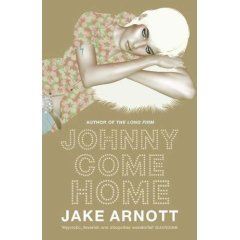
The culprit is Johnny Come Home, the most recent novel from Jake Arnott. Arnott brought us the celebrated Long Firm trilogy, three books – The Long Firm, He Kills Coppers and truecrime – which delivered a perfect blend of popular culture and crime, real life characters mixed with the fictional. Harry Starks, the fusion of Ronnie and Reggie Kray into a believable, dangerous Judy Garland loving gangster and Joe Meek, the legendary pop producer of the early 60s, are just two memorable characters. So I was excited about Johnny Come Home, Arnott’s first non Long Firm novel.
It’s familiar territory. Crime, the music business, fashion and homosexuality are typical Arnott themes. Set in the early 1970s, the book follows a set of characters on both sides of the law; a typical Arnott copper and typical Arnott suspects. Where the novel falls down is in the author’s choice not to include real people from history. Where The Long Firm imaginatively inserted the real Joe Meek into the action, Johnny Come Home presents a character called Johnny Chrome. An ageing rocker who grasps one last stab at stardom, reduced to singing over repetitive drumming tracks and prancing around in platforms. Yes, it’s a thinly disguised portrait of Gary Glitter.
Johnny Come Home is a disappointment because Arnott fails to inject into it any of the originality he’s shown previously as a writer. And that’s why I’m at a crossroads with this novel; I feel he’s a one-trick writer – and one trick he’s cunningly spread across the whole of his earlier trilogy.
Previous Page |
Next Page
