More trawling through my listening collection for the penultimate post in this mammoth A-Z music meme.
N
Admittedly I had a lot of trouble with N. I wanted to feature New Order, but thought it Manchester overkill, especially as I’ve previously featured Joy Division and Magazine. I toyed, very briefly, with Gary Numan. Then I remembered Kate Nash with this fantastic song. Miles above the higher-profiled Lily Allen.
O
In the early 80s Top of the Pops didn’t always know what to do with the more unusual chart bands. I’ve already featured the off the wall Associates, and here’s another Scottish band from the period who the BBC decided to surround with dancing girls. During this decade, pop was a party for the BBC. Fun, balloons and gurning DJs. Orange Juice were a great pop band, but somehow didn’t quite gel with the party they were thrust into here.
P
P is for Pink Floyd and my chance to feature the great Syd Barrett. The internet was a dream come true for Barrett obsessives, YouTube even more so, with obscure footage surfacing of his post-Floyd life. I’m going for the traditional, this promo for the Floyd’s extraordinary first record Arnold Layne.
Q
Next to I, Q was my most difficult letter. And I don’t like Queen, so who else to choose from? There’s always ? Mark and the Mysterians with this jolly tune.
R
I’ve had a funny relationship with the Rolling Stones, going through lengthy periods of not liking them at all. But this clip of Gimme Shelter is unbeatable. Notice the ? on Mick Jagger’s shirt? I haven’t just thrown this together you know.
S
It’s got to be The Smiths. Don’t accuse the young Morrissey of being a poser because, for me, The Smiths helped rid the world of the posers of 80s music. Morrissey could look cool in a pair of old jeans – there was no longer a requirement for the elitist fashion of the Kings Road. At last! When The Smiths emerged I’d already been wearing my granddad coat for a couple of years. Now I found a new avenue for my wardrobe – flowery shirts! Quiffs were allowed!
The Smiths were a part of my growing up, and I can align memories of where I was and what I was doing with the release of every one of their albums. I’m glad that Morrissey is still around, still successful and still making records, but he’s a shadow of his former self. He sings a rather pitiful version of This Charming Man with his current band, but here’s the original in all its glory. The business.
He brought the gun down upon my head:
“THIS IS THENORTH. WE DO WHAT WE WANT!”
It’s likely that you are probably in police custody if you haven’t noticed the excitement currently being generated around David Peace and Channel 4’s Red Riding adaptations of his novels. Having recently finished 1974 I was interested in seeing the television version, but approached it with a little more reserve than those who are hailing this as the tv event of the decade.
Peace’s world is a brutal one. Yorkshire in the 1970s where corruption and police brutality are rife. Reading the novels I am surprised just how debased the police were and do question the authenticity of the work, although the author maintains his belief that this is a true depiction of the depths the police found themselves in at the time. In 1974, a newspaper reporter is threatened by the police for being too nosy about a murder investigation. When he keeps digging, he is brutally attacked and his hand is broken in a car door. Later in the novel he is subjected to a vicious physical and verbal interrogation (this is nothing; in another Peace novel, 1977, a black murder suspect is beaten and humiliated into giving a semen sample by a group of jeering white officers). It’s a nasty and gruesome world, and it doesn’t help that Peace periodically slips into vivid dream sequences in his narrative and there are almost poetic sections that attempt to tie together his appalling imagery. So why is he so good?
I’m still deciding on an answer. Although 1974 has some flaws with a far from seamless plot, I’ve concluded that Peace is a talented writer with his breadth of vision. His writing is at times both hackneyed and remarkably fresh, weaving a tired noirish voiceover together with an almost Biblical vision of hell, corruption and horrible pain. With this in mind, I did wonder how Channel 4 would cope with him. 1974 is a sickening novel, and its voice – the reporter Edward Dunford – spends a lot of time getting sick. Often it’s the drink he consumes, but more so the seedy and terrible world he begins to peel apart. Dunford is a fascinating creation, going beyond the usual journalistic type you might expect from this type of fiction. The novel begins with his father’s funeral, and Dunford refers to his father’s watch and his father’s car in the early chapters, a young man inheriting his father’s artefacts. Is he ready for such an awful initiation into manhood that’s to come? Having shown the family and whatever values it might represent, Peace destroys them in the unfolding story of a terrible crime and the ruin of several lives and families. It’s an appalling, yet fascinating, chain of events that Dunford slips into.
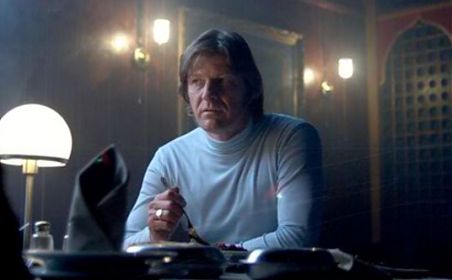
Channel 4’s adaptation looked promising, with an impressive cast including Warren Clarke, David Morrissey and Sean Bean (who was simply a revelation). The film started very impressively, depicting the boozy and masculine ruled world that Dunford inhabits. For me, the problems started with the liberties taken with Peace’s original novel. Whilst I accept that changes have to be made when adapting from page to screen I did find them quite brutal, and began to suspect that the adaptation was making changes in the arrogant stance that it was improving upon the original, which is always a dangerous stance to take. Characters were merged (three into one at one point), critical sequences were dropped when other less important ones were retained. Most alarmingly, the ending was changed, and although the Channel 4 adaptation retained the essence of the original it was too different from Peace’s unique vision.
The Red Riding series is still essential viewing, but I suspect that more essential is the books themselves. 1974 is difficult and hard to stomach, but considering the subject matter you can’t cut corners. David Peace has a point to make and a grim world to depict. You can only do this with a book.
Here goes with the second instalment of the bands A-Z. More sorting through old albums, more jotting down indecipherable lists and more time spent listening to obscure indie bands from the early 80s.
G
To begin with, a record I’d forgotten about from the late 80s by Australian band The Go-Betweens:
H
2009 sees the 30th anniversary of The Specials, with the ageing rude boys back on tour. Terry Hall has appeared under a number of different guises since they first split in 1981, including Fun Boy Three and this lot, The Colourfield. This is a one of his shorter lived combos dating from 1985. Later still, I saw Terry Hall live at the Shepherds Bush Empire in 1994, supporting The Lightning Seeds. His solo album from the same year was a big favourite at the time. Usually dubbed as a misery guts, this is an upbeat track that debunks the image.
I
Okay, I was a tricky one. Especially as I detest INXS and don’t really care much for The Inkspots. What else is there to choose? But then I remembered Janis Ian and this song from the mid seventies which I’ve always had a soft spot for.
J
Joy Division were near the top of my list before I’d even started sorting my alphabet. This is a band I’ve listened to through vinyl, CD and digital music. As a very young lad I listened to John Peel’s radio show in the early 1980s under the duvet cover. Literally, with tinny radio and earpiece. I hope my mother isn’t reading this. Those ten to midnight midweek slots were a revelation for me, opening a world of strange and brilliant music quite different and quite superior to the usual chart mush. Best of all was Joy Division.
K
A few years ago I bought the deluxe 3-CD set of Village Green Preservation Society for a Christmas present to myself. Call me an anorak, or more kindly a Kinks completist, but I love the album in any version. Ten or so years ago I saw Ray Davies in concert, still on top form.
L
I have a theory that John Lennon went completely mad in about 1968 and never really recovered from the loony world he fell into. This is one of my all time favourite clips, the only time he appeared as a solo artist on Top of the Pops singing Instant Karma. It’s brilliant, but crazy. Look into his eyes, not around the eyes, but into the eyes. He is mad.
M
To conclude here’s Magazine, featuring the very eerie Howard Devoto. Until next time enjoy this forgotten gem of a band…