3/5
Another view of a ruined London in a distant future. Like Will Self’s The Book of Dave, J.G. Ballard’s 1962 novel The Drowned World also considers a vastly changed city. With global temperatures soaring, London is drowned by advancing waters as giant alligators, snakes and other primeval nasties slither into view to reclaim the world. A band of scientists decide to stick around, charting the changes to a just about recognisable landscape of submerged department stores and tower blocks. Where Self uses modern landmarks to sketch out his future – the wheel on the South Bank features prominently – Ballard has his cast seeking refuge at the top of tall buildings, and the Planetarium – perhaps a more potent symbol in the early 1960s of Man’s imminent conquest of the stars – is reduced to a dark and menacing underwater cavern. The celebration of outer space becomes trapped in inner space, explored by divers in space age protective suits.
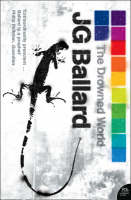
The Drowned World is a well written science fiction novel, but I was disappointed by its lost opportunity to exploit the landscape of London just that little bit more. The premise reminded me of one worthy of H.G. Wells, but – like the devastation in War of the Worlds – the Master would have relished in the chance to describe the city, district by district, as it was claimed by the sea. Ballard also doesn’t delve deeply into why this ecological disaster has occurred; it’s a natural one caused by solar flares (or something equally vague), rather than Mankind bringing it upon himself (he fails to predict the concerns of climate change that a modern novel would eagerly seize upon). Ballard’s interest lies in suggesting human degeneration, something that would have certainly interested Wells. Deep within us all lie fears of the primeval swamp, an innate terror of the reptiles and insects that lived on the Earth millions of years before us. As London is engulfed in water and rising temperatures, these fears also rise in Ballard’s cast – making interesting reading as they slowly succumb to nighmare and madness.
All these years on, The Drowned World survives as a worthy effort to produce a celebral and quality science fiction novel, a hard objective in the sci-fi weary world of the early 1960s. Maybe because of this Ballard treats his subject a little too seriously, there’s room for humour in even the most inhospitable of landscapes – at least on the page. There is also an uncomfortable shift into Heart of Darkness territory towards the end of the novel; an unwise move as it will always be impossible to emulate Conrad. But The Drowned World does have an effective ending, and it’s worth reading, especially as its author had boldly chosen to stick with a genre unfashionable at the time. Admirable.
4/5
At night Dave worked the mainline stations – Victoria and Paddington mostly. The west of London felt warmer in the winter, better lit, less susceptible to the chill of deep time. The fares were frowsty under the sodium lamps. In the back of the cab they slumped against their luggage, and Dave drove them home to Wembley, Twickenham and Muswell Hill. Or else they were tourists bound for the Bonnington, the Inn on the Park or the Lancaster – gaunt, people-barns, where maids flitted through the lobbies, cardboard coffins of dying blooms cradled in their arms. In the wee-wee hours he parked up at an all-night café in Bayswater and sat reading the next day’s news, while solider citizens lay abed waiting for it to happen. His fellow night people were exiguous – they wore the faces of forgotten comedians unfunny and unloved.
Will Self’s novel follows the mental decline of a London taxi driver called Dave Rudman. Seperated from his wife, estranged from his son, Dave slips further into a bleak and confusing world. Reality takes a very weird detour and, when broken, raving and wired on anti-depressants, Dave decides to write it all down. And he doesn’t come near to imagining the legacy he’s creating. Five centuries later, with London flooded and largely unrecognisable, its degenerate citizens worship a new Bible. A book found amongst the remains of the forgotten past – The Book of Dave.

The Book of Dave is a challenging yet compelling read. I was daunted at first by this lengthy novel and came close to abandoning it more than once. It wasn’t until I was at least a third of the way through that it began to grip; I was gripped by Self’s sheer inventiveness, his gift for language and his imagination. It’s one of the most difficult books I’ve read for a while, but Will Self is a highly original and bold voice. As the chapters alternate between Dave Rudman’s sorry life, his decline chronicled between the late 1980s and early 2000s, and the dreamlike future, the reader is given no easy task in making sense of this novel. But if the future chapters are at times unfathomable, they serve well as a nightmarish echo of the present day story. And for me, the contemporary setting worked the best. At first I found Self’s writing grimly reminiscent of Martin Amis’s approach to the city in London Fields; an over the top and detached view, but he soon surpasses any comparison with Amis and reveals what a distinct, mature and gripping talent he has become. And a great London writer – his view of the city is original, romantic and disturbing. And in my mind accurate – he knows his London.
Where in lesser hands The Book of Dave would result in a pretentious and unreadable mess, Self manages to pull it off. A great writer, an infuriating writer. At times I was genuinely moved by this book, and doffed my cap to his skill as an author. At other times I was screaming at him to cut the incomprehensible chapters and get back on track. But that’s Will Self. To get him, you’ve got to love him and you’ve got to hate him. But you can’t ignore him.
4/5
I was quite ill last week with a cruel stomach bug. When not in the bathroom, I took the advantage of spending my time curled up with the cats and reading. Luckily for me my companion was Essays in Love by Alain de Botton. This is a writer who first came to my attention a few years ago with the excellent The Art of Travel. But like countless others, de Botton was cast to the back of my mind with all the other writers I really must read again.

So I was very glad to get reacquainted . Essays in Love is de Botton’s very first book, written in 1993 when he was in his early 20s. Semi-autobiographical, it charts a relationship he has with a young lady called Chloe. The couple meet on a Paris to London flight and proceed to embark on a not particularly unusual love affair. What is remarkable however is de Botton’s writing, especially in how he can make the ordinary and common incredibly fascinating. The wonders of this chance encounter (he marvels over the incredible odds that they sat next to one another on that particular flight), are followed by all the joys and complications of love – that first breakfast together, the introductions to parents and friends, the unpicking of past histories, the rows, the doubts, the plucking up the courage to say I love you. Throughout the book de Botton examines the nature of one who claims to be in love, the characteristics of the passionate, the unwise and the irrational. Why does he have a terrible row with Chloe over her odd choice in shoes? Especially when his newsagent’s choice in shoes is even odder? If he loved his newsagent would he react in the same way? And why does he react with jealously to Chloe’s actions, even when he knows his suspicions are unfounded and absurd? And so on – pondering over every mad notion anyone in a relationship has ever entertained.
What let me down slightly that at times the situation did not always seem real. Alain and Chloe appeared a little too text book and showed all the too obvious stages in a relationship, from conception to bitter break up. At the end of the book, depressed and defeated the lonely de Botton slips into the self indulgent despair we’ve all slipped into. And that doesn’t make the final chapters easy reading. But perhaps this is his intention. Alain and Chloe are text book lovers because they are like us all, we notice the obvious hallmarks because we are all doomed to repeat the pattern.
Alain de Botton is a thoughtful writer with a neat line in self deprecation. He is also very funny, one of the few writers who can make me laugh out loud. Like his other work Essays in Love is peppered with references to philosophers and their writing but skilfully done as to not alienate the reader. What’s ultimately, and strangely, satisfying is that even though he writes very wisely about the subject he has probably learnt nothing. As he hints at the end, like all foolish lovers he will keep making all the same mistakes again.
Previous Page |
Next Page
