Time for the First Lines Meme
Monday December 1, 2008
in meme |
Time for the first lines meme. This is the meme where you quote the first sentence from your first post for every month of the last year.
January
David Thewlis is a British actor who has appeared on screen in Mike Leigh’s Naked, the violent thriller Gangster Number 1 with Malcolm McDowell and the ill-fated The Island of Doctor Moreau with Marlon Brando.
February
Since closing the last page of Cold Mountain I’ve been considering quietly forgetting this book, leaving a small gap and then swiftly moving onto the next.
March
A meme to keep things ticking over – if you’d like to join in.
April
Browsing in a second hand bookshop, I overhead a customer making an unusual enquiry.
May
Then we Came to the End by Joshua Ferris gave me one of the strangest reading experiences of recent years.
June
Devil May Care is a new James Bond novel written by Sebastian Faulks to mark the centenary of Ian Fleming’s birth.
July
Unusual for a music autobiography, Alex James hasn’t used a ghost writer for his memoir Bit of a Blur.
August
Inspired by Simon’s post I’ve been giving some thought to my holiday reading this year.
September
Call me unusual, but I found Tom Rob Smith’s Child 44 perfect summer reading.
October
It’s October time again so my choice in fiction is already turning towards the dark, haunted and peculiar.
November
Beware.
December
Time for the first lines meme.
Not the Planned High School Musical Post
Last weekend we went to see the new film called Igor. It wasn’t my first choice – I had a secret yearning for High School Musical 3 but my daughter had already seen it. So I went to the cinema with that horrible doubt you get when you’re paying to see a film you’re not really interested in. Igor is the latest of that ever growing list of animated features with famous, busy, okay I’ll do another animated film, actors providing the voices. This in itself is irritating for me; I always hang around at the end as the audience stampede around me for the exit, waiting for the credits to roll so I can check which actor voiced which character.
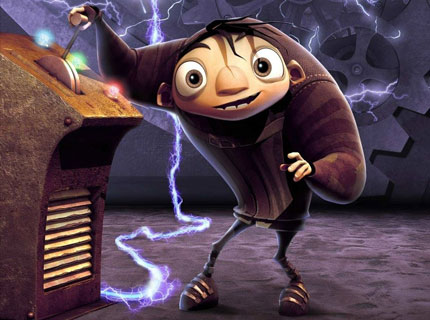
And I feel bad about being such a critic because, well, doesn’t he look cute?
But the problem I have with many of these films is that it’s often difficult to judge just who they’re aimed at. The humour in Igor went over the little heads of most of the audience we were part of (their spokesman became a small boy in front of us who kept standing up and asking “what’s he saying Daddy? What’s he saying?”). Igor is an animated take on the horror genre, working in many elements from Frankenstein. Our hero Igor is the hunchbacked assistant of a mad Frankenstein who decides to embark on some monster creating of his own. Some of the humour isn’t bad – Igor being sent to Igor school as a child and graduating with a yes masters degree. Well, I smiled at this one but nobody else found it amusing. Then there’s a joke about the not-very-evil professor who creates an evil lasagne. I nodded at this one, which was a kind of Eddie Izzard type joke (and Izzard coincidentally provides one of the voices). On the whole the humour is sub-Woody Allenish. Okay on its own but somehow out of place here. Conversations that follow this type of film are usually along the lines of “who was your favourite character?” and “what was your favourite bit?” Not “didn’t you find the humour just a little too self-depreciating?” or “do you think John Cusack’s future lies in comedy?”
Igor shouldn’t be singled out – there are dozens of examples – and I do think that the smart talking animated genre (especially when they’re animated animals – Madagascar 2 is on its way) is screaming out to be laid to rest. In Ratatouille, one of the main plot threads is about a nasty food critic (voiced by Peter O’Toole) who can close a restaurant forever with just one bad review. The other characters in the film are terrified by him, but I found this too much of a knowing joke for children and explaining why the O’Toole character was so feared simply spoilt the gag. And I suppose you can blame Woody Allen a little for voicing Antz, which has lead to countless comedians trying their hand at this sort of thing; Izzard, Jerry Seinfeld, Sacha Baron Cohen and the rest. it can’t be a bad job, unless of course you’re a proper actor like Ian McKellen who didn’t enjoy making Flushed Away that much because it simply tore him away from the contact of other actors. Like hobbits, for example.
I shall dutifully see Madagascar 2 when it comes out, and we already have Kung Fu Panda on DVD. I’ll get to see High School Musical 3 soon I hope. And so we stampeded out at the end of Igor, or at least I did after checking the credits to see if it really was John Cleese providing the voice of a minor character. I think it was, although there were too many little heads bobbing in front of me to know for sure.
She was at the end of a long ward, which had any number of cots and beds along the walls. In the cots were – monsters. While she strode rapidly through the ward to the door at the other end, she was able to see that every bed or cot held an infant or small child in whom the human template has been wrenched out of pattern, sometimes horribly, sometimes slightly.
Doris Lessing’s The Fifth Child is sometimes described as a horror story. It’s not one written at all in the traditional sense, and for this reason it’s one of the most disturbing novels I’ve read for some time.
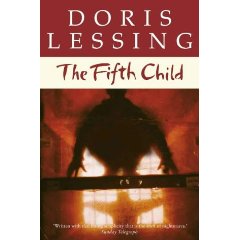
The problem I have, and perhaps the reason I’ve found this book so shocking, is that I can’t quite work out Lessing’s point of view. Take the quotation above, which is from a section about halfway through the novel. Harriet, the focal point of the story, has four healthy and what she (and perhaps Lessing) would call normal children. Her fifth child, Ben, is withdrawn, strange and potentially dangerous. Following a decision that may appear wild and unreasonable to today’s moral climate, Ben is placed in an “institution” – only rescued by Harriet in a moment of motherly guilt. It’s a situation (thankfully) difficult to picture now, although perhaps this was a feasible solution for nightmare children some thirty odd years ago (when the novel is set).
The Fifth Child is very effective in how Ben’s presence harms all around him, the bad seed of the family that causes his siblings to cower in fear. Lessing achieves this by her sparse and distanced writing style; and in this respect the novel is far superior to the leaden We Need to Talk About Kevin, a book that tackles much the same theme. However, the book continues to appear anachronistic; once Ben is rescued from the horrific institution he is handed to the part time care of a gang of unemployed youths who appear to have some calming influence on him. As a pre-school toddler he is allowed to roam freely with a group of young men and women. His parents simply want rid of him. How can we sympathise with their plight?
So Lessing impressed on one hand and let down on the other. Her writing style is chosen with great care, although the story goes in unbelievable directions. This novel affected me, although I didn’t find it the masterpiece I was expecting. I pitied Ben, as maybe I was supposed to do, but – influenced again by today’s moral climate where the media will seize upon stories of terribly abused children – the horror story is much more about a mother’s inability to deal with a misfit child.
Previous Page |
Next Page
