One must be careful about evocations, for the markers of old graves are not always accurate.
It’s October time again so my choice in fiction is already turning towards the dark, haunted and peculiar. What better place to start than H.P. Lovecraft? I’ve always found Lovecraft’s work terrifying because it is so convincing. Even though the stories are usually fantastic, there is so much attention to detail and specifics that he draws you much further into the macabre than any less precise writer would do. He also has the tremendous power of suggest and, like M.R. James, offers many a warning to the curious. As our opening quote hints, necromancy is a dangerous and never exact science.
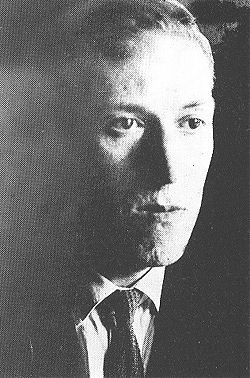
The Case of Charles Dexter Ward is an excellent example of Lovecraft’s art. In this short novel, a young man slips further into apparent madness and perversity after learning that one of his ancestors dabbled rather too successfully in the occult. Even though the tale is effectively chilling, Lovecraft shows the reader very little. The evil and unwholesome deeds usually take place behind closed and locked doors, and the reader only gets glimpses of the true horror from the reactions of innocent bystanders. We rely on half heard disturbing cries and howls and unpleasant and overwhelming odours, always a favourite of Lovecraft. The descent into the depths of Ward is also well marked by his observers, his strange nocturnal habits, brief sightings and the muffled voices and secrecy.
Lovecraft also sets his scene with great skill. The account of Ward’s ancestor, Joseph Curwen, comes across like a work of fact in its studious attention to detail. It’s almost as if there is a legacy of horror built up brick by brick over the years before Ward mistakenly uncovers it. The best passage of the book, however, is when the bystander Dr Willett decides to investigate things:
Slowly, as befitted one of his years, he descended the ladder and reached the slimy steps below. This was ancient masonry, his torch told him; and upon the dripping walls he saw the unwholesome moss of centuries.
I really didn’t think this a sensible outing, and found his later discoveries even more unpleasant, but like poor Dr Willett, I feel like I’m slowly descending into a slimy and dark pit when I read Lovecraft, and sometimes the text is so layered and dense I find myself putting the book aside before realising I have only read a small number of pages.
Lovecraft’s short story The Dunwich Horror is successfully horrifying for many of the same reasons as The Case of Charles Dexter Ward. The backstory and chain of unsettling events, the odours, the sightings and the sounds. Much is relayed as first hand accounts of startled (and surviving) witnesses. There’s also the documented evidence, often present in ancient writings, ciphers and manuscripts:
He had not left the manuscript all night, but sat at his table under the electric light turning page after page with shaking hands as fast as he could decipher the cryptic text …. Toward the middle of the next night he drowsed off in his chair, but soon woke out of a tangle of nightmares almost as hideous as the truth and menaces to man’s existence that he had uncovered.
The Dunwich Horror is exhausting in its perseverance to unsettle you. Like all of Lovecraft’s work, you are only privy to half of the real horror. Just a glimpse, with the true terror just around the corner. But I still welcome the coming of October…
After recently watching Bedazzled on late night tv I decided to seek out the spy thriller A Dandy in Aspic, which features Peter Cook in a cameo role. This 1968 film is set in London and Berlin and stars Laurence Harvey, Mia Farrow and Tom Courtenay. It’s filmed beautifully; London is damp and autumnal whilst Berlin is by contrast sunny and light, but while the cinematography is excellent the direction does owe a debt to The Ipcress File which came a few years before. There’s even a John Barry-eque haunting theme tune (actually by Quincy Jones), so while A Dandy in Aspic is a worthy addition to the cold war film canon, it does little more than tag along to the already set templates of the genre.
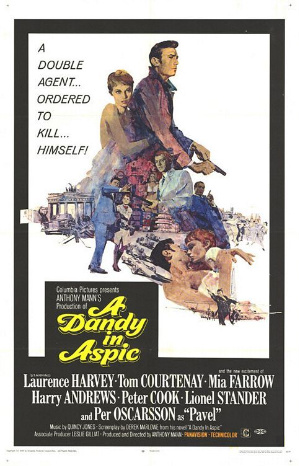
Harvey, one of the oddest leading men in film history, is quite wooden in this film. Farrow doesn’t shine particularly either, so it’s really up to the supporting cast to jolly things along. Whilst Courtenay seems misplaced in this movie, there’s excellent turns from Harry Andrews, Geoffrey Bayldon, John Bird (from tv’s Bremner, Bird and Fortune) and Mike Pratt (Randall in Randall and Hopkirk, Deceased). Also worth mentioning is Norman Bird, the supporting actor who appeared in countless British films in the sixties. Any casual student of this period in cinema will probably say oh, him again, whilst the posher critic might even say ah, the ubiquitous Norman Bird. But I always feel in safe hands when I spot Norman Bird. Then of course there’s Peter Cook, and although he only really has a tiny role he’s very good in it and it’s odd to see him in a rare serious acting role.
The cold war spy plot of A Dandy in Aspic is as complex and convoluted as the similarly themed Funeral in Berlin or The Spy Who Came in From the Cold. It’s been unjustly forgotten though, and it’s genuinely thrilling, although a touch deliberately confusing. Harvey plays a Russian double agent, coerced into travelling from London to East Berlin in order to carry out an assassination. There’s bluffs and double bluffs, and any attempt to further flesh out the storyline becomes bogged down with too many or is he? s and but did he? s. There’s also an interesting parallel with The Prisoner, where the but is he? s and an and does he? s also come into play.
The film’s director Anthony Mann died in Berlin in 1967 before filming was completed. Harvey picked up the pieces and finished A Dandy in Aspic, and while you can’t really see the joins this serious hiccup to production is obviously why this is an often erratic and bewildering film. For a decent spy thriller, your time is better spent with Michael Caine as Harry Palmer, and if it’s a mysterious, cerebral and absorbing sixties film then try The Quiller Memorandum. Now there’s a really good John Barry soundtrack. But A Dandy in Apsic is worth seeking out, especially for Peter Cook and Norman Bird completists like me.
Yes, I was misled by the cover design of Kate Summerscale’s The Suspicions of Mr Whicher. But pleasantly so, if it is pleasant to discover that at what first appeared to be a work of fiction is in reality a work of fact concerning a true Victorian murder mystery. Summerscale gives a very thorough account of a mystery that, to use a phrase of the type beginning to creep into sensational journalism at the time, gripped the nation.

In 1860 the middle class and seemingly ordinary Kent family were subject to intense scrutiny following the murder of their young son. Inspector Jack Whicher, one of the first police officers honoured the distinction of detective, is despatched to investigate and what followed was a case that spanned several decades. Summerscale also proves that fact is far stranger than any invented murder mystery, and superbly chronicles the events that drew the attention of Charles Dickens, Wilkie Collins and even Queen Victoria.
One of the reviews I’ve read of this account was careful not to spoil the outcome and intricate details for the reader. This is odd; even though the story is factual it has faded from memory – I’d certainly never heard of it – and at times you do become swept up in events, expecting a resolution that won’t come, at least not as neatly, as in most detective stories. And I feel I have to do the same, not spoil the outcome that is. The Suspicions of Mr Whicher is excellent reading, both as an account of Victorian society and as a critique of the sometimes sensational fiction of the day.
What I can prepare you for however is a sober alternative to the image of the detective in Victorian fiction, a man with undoubted reasoning as best personified by Sherlock Holmes. Gathering his evidence together, Jack Whicher suggests that Constance Kent, older sister of the murdered child, is guilty. His suspicions are discredited, Whicher falling into semi-disgrace, with a servant then emerging as the most likely suspect (Charles Dickens himself favouring the latter theory). Summerscale gathers her own evidence skilfully however, giving the reader a full and detailed insight into this compelling history.
Previous Page |
Next Page
