At this time of year it’s refreshing to find good quality writing high on the bestseller lists. Stephen King’s Just After Sunset is his return to the short story form, and these thirteen stories go far beyond the boundaries of simple horror fiction; the jacket blurb promises twist-in-the-tale stories of suspense, terror and dark comedy and whilst there is a fair degree of this, King is a writer who has easily outgrown any easy classification.
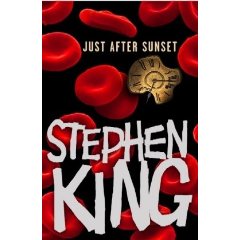
The stories in Just After Sunset are all very different but share a common ground in considering themes important to King. Willa, the opening tale, finds ghostly travellers stranded at a railway station. It’s an archetypal tale of a group of lost and disjointed people who eventually turn out to be ghosts. There’s nothing startlingly original about this story – it’s just a good Twilight Zone – but it’s very well written and stands to ease the reader into the mood of the collection. And that’s the best thing about this book – like listening to a favourite album, you’ll fall into a comfortable and refreshing groove.
King goes on to offer his own post-twin towers meditation in The Things They Left Behind, one of the best things I’ve read about the after affects of 9/11. Here, a man who survived the disaster because he called in sick to work that day, finds objects belonging to his dead colleagues mysteriously turning up in his apartment.
Other tales tackle the significance of dreams; Harvey’s Dream is a well executed story, as is Rest Stop, which looks at crime and justice, where a writer stops at a motorway convenience to overhear an act of aggression and has to make an important decision. Mute, a confessional story, looks at the same subject from a different perpective. King also includes a story that dates back thirty years. The Cat From Hell is worthy of inclusion, but illustrates just how much he’s matured over the years as a writer.
But the longer and more complex stories are the best. The devil is really in the detail here. The Gingerbread Girl begins slowly, where a woman takes up running as a pastime whilst also deciding to leave her husband and move away. It’s beautifully composed but also decidedly non-horror, which makes it all the more compelling when the lady is question ends up chased along a beach by a scissor wielding maniac. Although this is more than just a slasher movie put to paper; King documents the whole uncomfortable episode with detail and precision. A Very Tight Space, about what happens to a man when he is locked inside a stinking and stiflingly hot portaloo by an insane and vengeful neighbour, revels equally in the details of the plight of a man literally … knee deep.
Best of all is N. It’s a superb short story, which contains all the right macabre elements to make it brilliantly scary. It’s also extremely clever, reminding just what a craftsman Stephen King is. It concerns a psychiatrist and his patient, a man fully immersed in Obsessive Compulsive Disorder. His OCD stems from a discovery of a weird stone circle, and the belief that something awful will be unleashed if he doesn’t continue with his pattern of counting and rearranging. The compulsions, the precise mathematics and the latent horror, becomes addictive to all who chance across his sorry tale. In his end notes, King reveals that this story was inpired by Arthur Machen. There’s also echoes of M.R. James and H.P. Lovecraft. He’s carrying on the tradition: it’s easily the best thing I’ve read this year.
Just After Sunset proves it’s possible to be both successful and extremely good. King also makes it look all too easy. The struggling writer in us all can only bow in deference. God, I’d hate the man if I didn’t respect him so much.
Everybody loves The Wicker Man. The 1973 film, that is, and not the 2006 remake starring Nicolas Cage. From what I can gather, everyone hates that Wicker Man. But what exactly was wrong with it? Was it just another case of a bad remake of a classic film (just like with Psycho and Get Carter)? Is it really that bad? Against my better judgement, I recently spent an evening with the Cage Wicker Man.
According to its director Robin Hardy, the 1973 original was treated badly by its distributors. The film was edited fairly brutally and eventually released as a B-movie to support Don’t Look Now. Rumour has it that some of the deleted scenes were buried under the M4. The film drifted in obscurity for a while and then began to gain something of a cult following, receiving frequent tv showings, and eventually a director’s cut DVD release. Hardy can’t really say the film is ignored any more. It’s rightly cited as a classic and is possibly the only British film made in the 70s that continues to receive five star reviews in film guides and listing magazines. Its own star, Edward Woodward, is now always asked about the film in interviews and recently made a short documentary with the film critic Mark Kermode where they revisited the original locations. Christopher Lee, who also appeared in the film, says it is his best role and can’t stop talking about it.
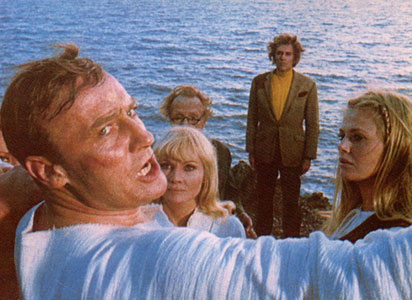
“Oh God! Oh no!”
The Wicker Man sits awkwardly alongside the horror films being made in Britain at the time, and this is probably why it has endured so well. For the first half, it’s possible to be forgiven for thinking that this isn’t horror at all. Woodward plays a devoutly religious policeman who’s lured to a remote Scottish island to investigate the disappearance of a young girl. He finds a cut off yet seemingly self sufficient pagan society, laughing at his Lord and indulging in sexual ritual (some of it looks fun, especially when Britt Ekland gets her kit off, but Woodward’s having none of it). The Wicker Man stands up to repeated late night viewings, both for its careful build up to a dreadful ending and for its most unusual and wonderful soundtrack. It’s the role of a lifetime for Woodward and probably Lee as well.
Surprisingly for a Hollywood movie, the new Wicker Man doesn’t change an awful lot, although what it does change leads to its ultimate downfall. Cage plays a cop (Edward) who’s called to a remote island … yes it’s the same. But the alteration is that the missing girl (Rowan Woodward – geddit?) is revealed as his daughter, thus altering the original premise that the policeman – a king-like, willing fool – was pure for sacrifice (a virgin). Director Neil LaBute also decides to make his island a feminist nightmare – run by women where the men are mute and dominated. This is one of the reasons why the film was slated, especially as Cage enjoys throwing a few punches, and it’s difficult to defend this plot change, although it was effective to have a woman (Ellen Burstyn) in the Lee role.
But I found the reception to this Wicker Man far too unkind. There is an underlying creepiness to the film, and the end is almost as effective as the original (I was on the edge of my seat because I really thought they were going to fudge it and have Cage rescued). And really strangely, there are a few fleeting references to Don’t Look Now with Cage pursuing a small child in red. Perhaps they forgot at times which film in the original double bill they were remaking. Now this film has earned its place in late night tv slots, I suppose LaBute will take Hardy’s place in moaning about its treatment. Although I can’t see this one being hailed as a classic in 35 years. But everyone who loves The Wicker Man, the 1973 one, should give it a chance.
Sometime in New York City
Yet even at that tender age, he glimpsed ‘the little child inside the man’, to quote one of John’s last pieces of self-analysis. ‘I remember that Alice, our black cat, had jumped out of the window after a pigeon and died, and I remember that was the only time, I think, I ever saw my dad cry.’
Ah, the terrible inevitability of coming to the end of a Lennon biography. Following the Beatles break up in 1970 the following ten years just whizz by; heroin, primal scream therapy, the move to New York, the political sloganeering, the lost weekend, the birth of Sean and John’s retirement. The Double Fantasy comeback and finally…
Philip Norman pieces together Lennon’s last years better than any other biographer in this, the end of John Lennon: The Life. In 1975, following the birth of Sean, John Lennon decided to walk alway from the music business as his recording contract coincidentally ended in the same year. He chose not to renew it, enjoying as he would later put it, the life of a house-husband, almost pioneering the role reversal of husband at home and wife at work. Baking bread, singing lullabies, bliss. Norman, however, reveals that Lennon was far more active than other accounts have let on. As well as extensive travelling (several visits to Japan, and a sailing holiday in the Bermuda Triange) he had fleeting contact with Paul McCartney and the two were to meet, if not frequently, but had a less estranged relationship than we might believe.
In the late 70s a US comedy show challenged John and Paul to revisit the studio to stage a reunion. Not only was an amused Lennon watching at home in the Dakota, but McCartney was sitting with him, and the two almost called a taxi to take up the dare before eventually abandoning the idea. At other times in this period the Beatles came close to reforming; as well as tempting financial offers John and Paul once played to a substantial audience at a beach party, and Lennon continued to write and demo songs in this supposed quiet period, one of which became Free as a Bird.
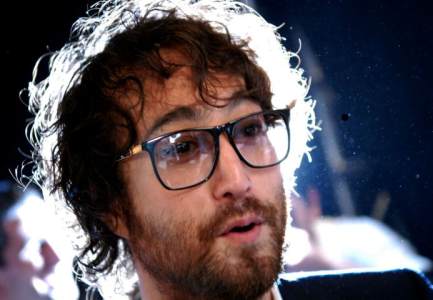
Norman’s final chapters are beautifully written, almost moving, as Lennon finds the peace that eluded him through most of his life (even when he was demanding that peace be given a chance). As the inevitable end comes into view, he draws the story to a conclusion without dwelling on the aftermath of his murder and his legacy since then. Instead the book closes with a meeting between Norman and Sean Lennon. Only aged five when his father died, his memories are obviously hazy, but this makes from a memorably impressionistic account of the man, the dad who sometimes lost his temper but who cried when the family cat died.
John Lennon: The Life gives a believable snapshot of the man’s state of mind when he died. Enthusiasm for what the future held (further recording, a planned trip to England) was tinged with the Beatly past he couldn’t quite shake off – the awkward presence of Paul in the world (his rival forever), continued friendship with the ever-amiable Ringo and growing resentment towards George Harrison (who chose to barely mention Lennon in his own autobiography). And a strangely unkind disregard for the brains behind the scenes, George Martin. If he couldn’t quite escape the Beatles, I still read a growing sign of maturity and inner strength, beginning to be achieved at last if all too briefly.
Previous Page |
Next Page
