The Book Tower

RSS feed

No Quantum Leap

Sunday November 9, 2008 in |

Two years ago, my very first film review here was for Casino Royale, and I mused that Daniel Craig could possibly equal, if not supplant, Sean Connery as the best incarnation of James Bond. After seeing Quantum of Solace I’m still of my 2006 opinion. Craig is still very much the number two Bond almost ready to push aside Connery’s one, which is an unusual stance to take considering that the 22nd Bond film is generally very disappointing.
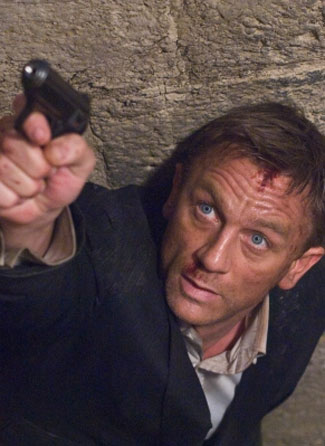
Daniel Craig as James Bond

What I found a huge mistake was that Quantum of Solace follows directly on from its predecessor Casino Royale, the two movies effectively making one whole. So if you’ve not seen the previous film in the last 24 hours you’re stuck, and I don’t think I’m a rare example of having an only hazy memory of the last film. If I wasn’t so shy, I would have stood up, called the rest of my fellow audience aside and said “right – that’s Bond up there and Judi Dench is M. Other than that I have no idea of who these other characters are who they keep referring to. Do you?”

If Craig and Dench are my only terms of reference, I found the Judi Dench presence in this movie somewhat stifling. As M should really only be an incidental character, she’s given too much prominence in the role. M should never really threaten to overshadow Bond, and where Dame Judi should only be giving a cameo she has almost as much screen time as Craig. Dench is everywhere, turning up in hotel rooms, lobbys and lifts, even London East End tower blocks so she can berate our hero in her school mam way. I half expected Craig to open the fridge door at breakfast time to find Dench sitting beside the milk cartons, looking down her nose and muttering try not to make the tea too strong this time, Bond.

So picking up from where Casino Royale left off, Quantum of Solace finds Bond still in a state of unrest following the death of love interest Vesper Lynd. The man who he corners at the end of Royale is dragged in for questioning at the beginning of Solace, and the film begins with an impressive car chase (that would have been more impressive if I hadn’t already seen it on a recent South Bank Show). Just when we think we’re sitting down to some comfortable Bond chat there’s another chase sequence, which echoes the opening of Royale for speed and physicality. Here Bond chases a double agent across Italian roofs and ascending (and rapidly descending) a bell tower. It’s very well done, although looking back I think that director Marc Forster played all of his best cards far too early as what follows falls far from expectation.

Daniel Craig continues to excel in the role, which makes it all the more tragic that this film is so messy. He’s totally convincing as a man who, if you pick a fight with him then you’re going to lose. If he asks you a question then it’s best to respond clearly and loudly. If he’s sent to kill you then you’re going to die. Craig portrays the ruthless and competent assassin perfectly, best shown where he swiftly disposes of a man in a Haiti hotel room. This is a scene that stretches right back to Connery’s fight with Robert Shaw on the train in From Russia With Love and proving that we still don’t need gadgetry and special effects, just a well coreographed punch up. The only thing that spoilt it for me was the cynical product placement. No, I still don’t want an Omega watch.

The makers of this film have claimed that they wanted to dispense with the cartoonish Bond villains of old. Gone are the white cats, metal hands and teeth, and in their place, at least as the film sketches out at the beginning, is the allusion to the modern threat of terrorism, that anyone, however apparently benign, could be a menace – as M grows increasingly concerned that the enemy is buried within her ranks, ready to turn on her when given the signal. There is a watered down villain, and in this villainous role Mathieu Amalric makes the most of what he is given, but it’s obvious that he wants to be a classic Bond baddie, snarl, utter memorable lines and stroke an albino moggie. Small and weedy, he comes across as a greasier and nastier Roman Polanski, which is odd as buried in the mad plot of this film is a distant echo from Chinatown‘s theme of heat and drought. But, like the other themes in this movie, it isn’t explored thoroughly.

It’s the plot that ultimately ruins Quantum of Solace, both for the big headed belief that an audience will come with Casino Royale fresh in their minds and for the fact that, for a film that wants to be ground breaking, the storyline is hackneyed and unoriginal. And the stupid title. Seems to be that they only pick titles with a pair of words with o s – Casin o, R o yale, o f and bloody s o lace. Then they can string the two o s together in the title sequence to make 007. So you could equally call it Quantum of Booze or Expresso Bongo. Or Bored by Bond. At least the theme tune, written by Jack White, is very good – even though it uses a few token John Barry references. I still have high hopes for Bond, but Craig’s next outing requires a fresh story and a lot less Dench.

Comments [2]
Page 56 Meme

Saturday November 8, 2008 in |

From The Pickards.

  1. Grab the nearest* book.
  2. Open the book to page 56.
  3. Find the fifth sentence.
  4. Post the text of the sentence in your journal along with these instructions.

*Note: nearest means the one which is closest to you, as opposed to that one on your shelves which is really cool or will make you look clever.

The nearest book to hand is How to Train Your Viking by Cressida Cowell. Page 56 line 5 is this:

What are we going to DO???

To put things squarely into context, this note of panic is raised by a character called Fishlegs to their associate Hiccup. And, worryingly, Hiccup’s reply is this:

There’s nothing we CAN do…

Comment

Life With the Onos

Friday November 7, 2008 in |

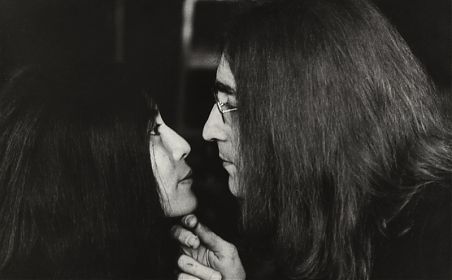
A little old lady from Wigan or Hull wrote to the Daily Mirror asking if they could put Yoko and myself on the front page more often. She said she hadn’t laughed so much in ages. That’s great! That’s what we wanted. I mean, it’s a funny world when two people going to bed on their honeymoon can make the front pages in all the papers for a week. I wouldn’t mind dying as the world’s clown. I’m not looking for epitaphs.

Looking at another hefty chunk of Philip Norman’s John Lennon: A Life, roughly covering 1963-9 – the period which started with the Beatles becoming seriously big, their conquest of Britain and the US and the beginning of their prolific run of brilliant albums, and ended with things going seriously sour, petty and bitter fallings out – the at times acrimonious break up of the band.

John Lennon and Yoko Ono

Norman continues in his usual self-appointed role of historian, carefully setting out the facts of Lennon’s life and avoiding any temptation to fancy or judgement. As the book continues however, he is unable to resist injecting into proceedings his benefit of hindsight. He’s very quick to find prophecy in spur of the moment quotes, for example Yoko Ono fearing that she would one day end up alone in a New York apartment, and subtle turning points in Lennon’s life. With his relationship with Paul McCartney, 1968 is ruefully labelled “the last year they would be friends”, and of the brief reconciliation between Lennon and his father, “the spell was broken, never to be recaptured”. And at times Norman takes this theme a little too far, finding the song Happiness is a Warm Gun too painful to listen to for its obvious connotations, and constantly nudging us with the fact that – in a few more chapters – Lennon will die.

But despite my nit-picking, I continue to find this a mostly excellent biography. And despite how many Beatle books I’ve read over the years, it is still incredible to believe just how much happened between 1963 and 1969. Putting the output aside, albums and singles in double figures, the films and endless tours (not to mention two books by John as a published author), there is the breathtaking speed of events in Lennon’s own personal life. His increasingly dull married life in rich and comfy Weybridge, controversy in 1966 with the Beatles fleeing the Philippines after seriously p-ing off Imelda Marcos, more trouble in the same year with the “bigger than Jesus” debacle, drugs, more drugs and lots of drugs, the death of Brian Epstein and the Beatles flirtation with the Maharishi. If all these events weren’t enough, Norman spends more time than any on Lennon’s meeting with Yoko Ono…

As biographers go, Norman is extremely kind to Yoko Ono. This is possibly because she contributed to his research for the book, so it’s odd that she eventually withdrew her support claiming that Norman had been “mean to John”. Finishing the story (in the third and final posting) may reveal her reasons why. But Norman gives the best account of their meeting and early relationship that I’ve ever read, revealing it as far more complex than Lennon made out in his later years, when he tended to look back on their courtship with rose-tinted little round glasses.

Factually, Norman has really done his homework here, and I forgive him for misquoting a song lyric or two (In I’m So Tired, Sir Walter Raleigh is a stupid get, not git) and describing the Magical Mystery Tour soundtrack as the “accompanying album … selling … five hundred thousand in Britain”. It was a double EP set in this country, Philip, the album came later. Sorry to be pedantic, but you’re getting paid for this mate.

I find myself continuing to read Lennon biographies as I face the prospect of outliving the man for two reasons. They’re both obvious. One is to gain some insight into the creative process of the Beatles, but as this is something that’s been done so well by Ian Macdonald in Revolution in the Head Norman doesn’t attempt to try too hard on this part. His accounts of Revolver through to Sgt Pepper and The White Album – three of the best albums ever made – are sadly pedestrian. Secondly, I just want to find out what Lennon was really like, especially as the memory I had of him (brief though it was) has faded. Norman does this very well, and there are many well constructed memories and accounts of his peculiar yet (mostly) charming personality. So far, he’s not been mean to John.

Comment

Previous Page | Next Page