Not the Planned High School Musical Post
Last weekend we went to see the new film called Igor. It wasn’t my first choice – I had a secret yearning for High School Musical 3 but my daughter had already seen it. So I went to the cinema with that horrible doubt you get when you’re paying to see a film you’re not really interested in. Igor is the latest of that ever growing list of animated features with famous, busy, okay I’ll do another animated film, actors providing the voices. This in itself is irritating for me; I always hang around at the end as the audience stampede around me for the exit, waiting for the credits to roll so I can check which actor voiced which character.
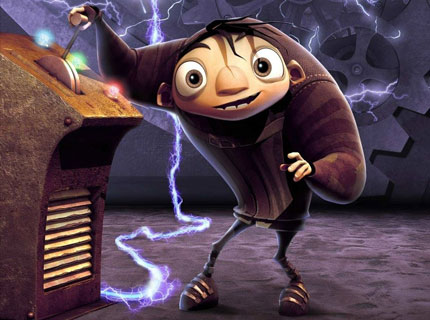
And I feel bad about being such a critic because, well, doesn’t he look cute?
But the problem I have with many of these films is that it’s often difficult to judge just who they’re aimed at. The humour in Igor went over the little heads of most of the audience we were part of (their spokesman became a small boy in front of us who kept standing up and asking “what’s he saying Daddy? What’s he saying?”). Igor is an animated take on the horror genre, working in many elements from Frankenstein. Our hero Igor is the hunchbacked assistant of a mad Frankenstein who decides to embark on some monster creating of his own. Some of the humour isn’t bad – Igor being sent to Igor school as a child and graduating with a yes masters degree. Well, I smiled at this one but nobody else found it amusing. Then there’s a joke about the not-very-evil professor who creates an evil lasagne. I nodded at this one, which was a kind of Eddie Izzard type joke (and Izzard coincidentally provides one of the voices). On the whole the humour is sub-Woody Allenish. Okay on its own but somehow out of place here. Conversations that follow this type of film are usually along the lines of “who was your favourite character?” and “what was your favourite bit?” Not “didn’t you find the humour just a little too self-depreciating?” or “do you think John Cusack’s future lies in comedy?”
Igor shouldn’t be singled out – there are dozens of examples – and I do think that the smart talking animated genre (especially when they’re animated animals – Madagascar 2 is on its way) is screaming out to be laid to rest. In Ratatouille, one of the main plot threads is about a nasty food critic (voiced by Peter O’Toole) who can close a restaurant forever with just one bad review. The other characters in the film are terrified by him, but I found this too much of a knowing joke for children and explaining why the O’Toole character was so feared simply spoilt the gag. And I suppose you can blame Woody Allen a little for voicing Antz, which has lead to countless comedians trying their hand at this sort of thing; Izzard, Jerry Seinfeld, Sacha Baron Cohen and the rest. it can’t be a bad job, unless of course you’re a proper actor like Ian McKellen who didn’t enjoy making Flushed Away that much because it simply tore him away from the contact of other actors. Like hobbits, for example.
I shall dutifully see Madagascar 2 when it comes out, and we already have Kung Fu Panda on DVD. I’ll get to see High School Musical 3 soon I hope. And so we stampeded out at the end of Igor, or at least I did after checking the credits to see if it really was John Cleese providing the voice of a minor character. I think it was, although there were too many little heads bobbing in front of me to know for sure.
She was at the end of a long ward, which had any number of cots and beds along the walls. In the cots were – monsters. While she strode rapidly through the ward to the door at the other end, she was able to see that every bed or cot held an infant or small child in whom the human template has been wrenched out of pattern, sometimes horribly, sometimes slightly.
Doris Lessing’s The Fifth Child is sometimes described as a horror story. It’s not one written at all in the traditional sense, and for this reason it’s one of the most disturbing novels I’ve read for some time.
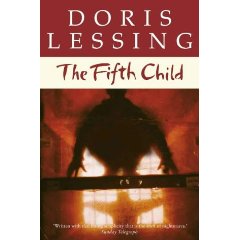
The problem I have, and perhaps the reason I’ve found this book so shocking, is that I can’t quite work out Lessing’s point of view. Take the quotation above, which is from a section about halfway through the novel. Harriet, the focal point of the story, has four healthy and what she (and perhaps Lessing) would call normal children. Her fifth child, Ben, is withdrawn, strange and potentially dangerous. Following a decision that may appear wild and unreasonable to today’s moral climate, Ben is placed in an “institution” – only rescued by Harriet in a moment of motherly guilt. It’s a situation (thankfully) difficult to picture now, although perhaps this was a feasible solution for nightmare children some thirty odd years ago (when the novel is set).
The Fifth Child is very effective in how Ben’s presence harms all around him, the bad seed of the family that causes his siblings to cower in fear. Lessing achieves this by her sparse and distanced writing style; and in this respect the novel is far superior to the leaden We Need to Talk About Kevin, a book that tackles much the same theme. However, the book continues to appear anachronistic; once Ben is rescued from the horrific institution he is handed to the part time care of a gang of unemployed youths who appear to have some calming influence on him. As a pre-school toddler he is allowed to roam freely with a group of young men and women. His parents simply want rid of him. How can we sympathise with their plight?
So Lessing impressed on one hand and let down on the other. Her writing style is chosen with great care, although the story goes in unbelievable directions. This novel affected me, although I didn’t find it the masterpiece I was expecting. I pitied Ben, as maybe I was supposed to do, but – influenced again by today’s moral climate where the media will seize upon stories of terribly abused children – the horror story is much more about a mother’s inability to deal with a misfit child.
Danger: Diabolik
Sunday November 23, 2008
in 60s cinema |
Danger: Diabolik is a film with 1968 splashed all over it. 1968 writ large, with swirling pop art colour, Ennio Morricone music and a European setting complete with fast cars on looping mountainside roads. John Phillip Law stars as our hero – a cartoon man in a cartoon world peppered with glamourous girls, space age hideaways, bombs and snarling baddies.

Diabolik is an unstoppable leather clad jewel thief, living in an underground lair that appears to share the same architect and technical advisers as the Batcave. It’s full of huge flashing computers, plastic domes and walkways; the 60s vision of how everyone might live in the year 2000. When not involved in crime, Diabolik and his girlfriend Eva (Marisa Mell) take showers and romp around in a bed full of money. It’s not a bad life, although our hero can’t resist that irresistible urge for danger. At one point, after Diabolik wakes after sleeping for 20 hours, Eva confesses that she slipped him a pill – otherwise his leisure time would simply make him too bored. As Law’s acting rarely goes beyond eyebrow-raising that would teach Roger Moore a thing or two, it’s unkind yet true to observe that it’s difficult to tell the difference between the sleeping and waking Diaboliks.
Although a joint French-Italian production (and produced by Dino de Laurentiis), Diabolik appears to be set in the generic “Europe” of 60s films. It’s exotic, sexy and exciting, most probably Italy but never actually named. It doesn’t matter who’s who and from where, as the best parts of the film are where nobody speaks at all. Law, an American, has so few lines he makes Clint Eastwood look overworked. Terry-Thomas turns up, the archetypal Brit official, for a welcome turn although the film is almost ruined by the terrible dubbing into English of all the other actors. The plot is hardly worth going into at all. It’s simple comic stuff, in the days before this sort of thing began to take itself either too seriously or became bogged down with in jokes. This is a film without pretence or irony.
Despite the silliness, the director Mario Bava does claw back some credibility with the action scenes. The sight of Diabolik climbing up the sheer stone face of a tower is very well done, as is his subsequent escape from said tower. The car chases and gadgetry is also fun, as is the film’s totally absurd ending, where an unfortunate accident leaves Law encased in gold. I wouldn’t worry, though, as it doesn’t appear to faze him, and he appears perfectly happy reduced to mere eye acting. I would have probably advised against some of the other stunts in the film, such as a leap from an aircraft and a train wreck, simply because the budget doesn’t stretch to it.

At times Diabolik comes across as a weaker version of Joseph Losey’s 1966 Modesty Blaise. This is almost like the B-side of Modesty Blaise, cheaper and dafter. And where Terence Stamp and Monica Vitti, the leads in Losey’s film, can at least act a bit, there’s not much evidence of it here with Law and Mell. But Diabolik does always feature in must see film lists of obscure movies that are bandied around. It certainly is very obscure, and it’s likely that the dubbing issue has caused tv schedulers to keep it at arm’s length. Worth seeing though, for the very good soundtrack, and it’s kind of sad to see Law and Mell together, now both no longer with us. And as Mell eventually descended into obscure porn films, this is probably the only film of hers even remotely available.
Previous Page |
Next Page
