Halfway House
Wednesday May 28, 2008
in books |
A benefit of writing online book reviews is that you don’t have to finish reading a book before you start writing about it. I usually do, because it tends to make sense, but quite often I list books I’m intending to read before going off to read an entirely different list. And quite often I abandon books I’m not enjoying halfway so I can sit at my keyboard and rant about them. This time it’s a very odd situation; a slim and easy to read novel that’s nevertheless taking me an eternity to read. Several times I’ve been on the brink of abandoning it through sheer frustration. Is this a below par novel because I’d sooner put it down and watch The Apprentice? Must I give up because the book is becoming so battered and tatty with age that it will probably disintegrate before I stop reading it? Is it a below par novel because I am begging for something more absorbing to throw itself in my path?
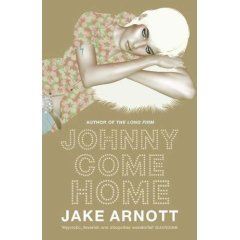
The culprit is Johnny Come Home, the most recent novel from Jake Arnott. Arnott brought us the celebrated Long Firm trilogy, three books – The Long Firm, He Kills Coppers and truecrime – which delivered a perfect blend of popular culture and crime, real life characters mixed with the fictional. Harry Starks, the fusion of Ronnie and Reggie Kray into a believable, dangerous Judy Garland loving gangster and Joe Meek, the legendary pop producer of the early 60s, are just two memorable characters. So I was excited about Johnny Come Home, Arnott’s first non Long Firm novel.
It’s familiar territory. Crime, the music business, fashion and homosexuality are typical Arnott themes. Set in the early 1970s, the book follows a set of characters on both sides of the law; a typical Arnott copper and typical Arnott suspects. Where the novel falls down is in the author’s choice not to include real people from history. Where The Long Firm imaginatively inserted the real Joe Meek into the action, Johnny Come Home presents a character called Johnny Chrome. An ageing rocker who grasps one last stab at stardom, reduced to singing over repetitive drumming tracks and prancing around in platforms. Yes, it’s a thinly disguised portrait of Gary Glitter.
Johnny Come Home is a disappointment because Arnott fails to inject into it any of the originality he’s shown previously as a writer. And that’s why I’m at a crossroads with this novel; I feel he’s a one-trick writer – and one trick he’s cunningly spread across the whole of his earlier trilogy.
When I was 20 I worked briefly as an assistant in a record shop. It was easily the worst job I’ve ever had; the oppressive concrete of Hammersmith Broadway, the rude, insistent, positively insane customers I had to face. And the odd types who work in record shops. And the sheer monotony of a job that somehow fails to meet the romanticism you first attach to it. So I was interested in reading Catherine O’Flynn’s What Was Lost, the first novel of a writer who’d endured the same job as me and chosen to set her debut work in a huge, sprawling shopping centre.

What Was Lost reminded me a lot of Jonathan Coe; similar in writing style and similar in how a mystery spanning two decades lies at its heart (although it’s years since I’ve read it, I was reminded a lot of Coe’s House of Sleep). O’Flynn’s mystery surrounds the disappearance of a young girl who, we learn from the opening chapters, daydreams through her waking hours as a would-be detective. Essentially we are in Curious Incident of the Dog in the Night Time territory, but the novel begins to pick up speed when it jumps from 1984 to 2003. A long time after her mysterious disappearance we follow some of the shopping centre staff who are all, as you might expect, linked in some way to the girl.
Laura is our record shop assistant enduring the nightmare customers and staff, whose own brother also disappeared after being linked to the disappearance and questioned by the police. Kurt is a security guard, who sees a mysterious girl on the CCTV late a night, apparently lost in the empty, labyrinthine corridors. The novel manages to successfully combine humour with sadness; there are some very funny scenes surrounding Laura’s working days (her aggressive, burnt out colleague in the easy listening section is quite hilarious), and there are also many moments of dashed hopes and regret in Kurt’s background story. But best of all What Was Lost offers a very subtle and eerie ghost story, and whilst the solution of the “whodunnit” is not particularly surprising, the explanation of the “whydunnit” is very well constructed. A fine debut.
Putting the Book Down
Tuesday May 13, 2008
in books |
Anyone who occasionally looks at these pages may be aware that I feel bad about abandoning books. I feel a duty – however odd – to finish a book once I’ve started it. Probably wrongly, I often feel it’s something lacking in me when I give up on a book. I feel am unable to appreciate something that’s often very widely acclaimed, I’m just too dim to get it when everyone else has.
No Laughing Matter by Angus Wilson is a book that’s sat on my shelves for longer than I can remember. My yellow paperback copy has a inscription written by an old work friend (long since lost) who gave me the copy as a gift. Giving up on a book that I always meant to get round to makes the process all the more disheartening. The novel came back to my attention as it’s one that often turns up in top 100 lists. It’s one of Peter Boxall’s 1001 books before you die. It also turned up in last Saturday’s Guardian, named by several contemporary authors as the out of print book they’d love to see available again.
So what’s my problem? I found No Laughing Matter, like most of Wilson’s work, very difficult to get into. I also found it incredibly dated for a novel only written in 1967. Perhaps because it looks back on the period between the two world wars in its microscopic study of an English middle class family, although there are some similarities with Waugh – and I don’t find his work as dated. There are also echoes of Joyce, and it’s here – Wilson’s irritating experimentation – that led me to toss the book aside. I’m really sorry. But the hot weather at the moment inspires reading in the park beneath a shady tree – and I don’t want to spoil such rare perfect days curled up with a novel I can’t stand…
Picking books from must read lists often has this effect on me. It’s the same with films – and I wouldn’t want to be watching Citizen Kane on a sunny day either.
Previous Page |
Next Page
