Devil May Care is a new James Bond novel written by Sebastian Faulks to mark the centenary of Ian Fleming’s birth. Where many authors might take the opportunity to apply a modern makeover to 007 this is very much Faulks writing in the style of Ian Fleming. He is ever careful to avoid slipping into parody, and reading the opening chapters confirms that Faulks has done his homework on Bond’s history. He’s also a wise choice for the job, his diverse back catalogue including such stunningly different novels as Birdsong, On Green Dolphin Street and Engleby prove he’s keen to turn his hand to most things. And we can now tick spy fiction off as another of his successes.
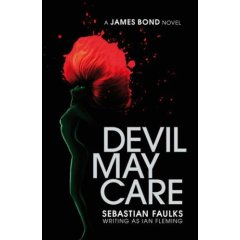
Like the Fleming back catalogue, Devil May Care isn’t great literature but it’s a great spy novel. Faulks effortlessly recreates the 1960s to follow where the original series ended. The Cold War comes to life, and the technology of the day charmingly shines through (agents having to make landline calls, and double agents cunningly pulling telephone wires out of their sockets). There’s also all the ingredients of classic Bond – the beautiful girl, crazed Oriental assassin, super villain with a grudge and a deformity. Add to that the wining and dining, a dozen trademark Bond hot showers, and a classic train-bound fight to the death. And throughout Faulks manages to plant the image of Sean Connery in my mind. At least his physique and looks; the action scenes reminded me of the recent authentic version of Bond as portrayed by Daniel Craig.
Tired, broken and in need of a drying out period James Bond is enjoying a well earned sabbatical. But as with most Bond novels, holidays are cut short by a call from M. Returning to London Bond notices the young, long-haired and carefree on the streets and smells the tell-tale aroma of cannabis. It’s 1967, and drugs have a firm foothold in Devil May Care. Bond is on the trail of a criminal mastermind who is planning to maim England badly through drugs. The novel takes time, there’s long passages of dialogue and an excellent early stand-off in the form of a tennis match between Bond and his enemy before things pick up. Faulks sets the scene wonderfully. There’s also the international flavour you might expect. As well as London, the action shifts from Paris to Iran and Russia.
Published by Penguin, the end papers of the book add Devil May Care to the Bond canon that includes Fleming’s fourteen original books and, interestingly, Charlie Higson’s four young Bond novels. The Kingsley Amis Bond effort from the late sixties is not included, nor the various novels that appeared in the eighties and nineties. If Sebastian Faulks is the official heir to Fleming then it’s unclear if he’s willing to write any more novels. If he isn’t, then this is a shame. Devil May Care is highly enjoyable, and I fully expect the paperback blurb to include the cliché “enjoyable romp”. Add to that “Bond is back – at his best”.
Room for One More Indiana Jones Review?
In an attempt to explain its flaws, the new Indiana Jones film has been described as a popcorn movie. But I’d like us to just hang on a minute. I really don’t like this. Why has this suddenly become a derogatory term? Point A is that, when he really tries hard, Steven Spielberg is a cinematic genius. Go away and watch, or watch again, Jaws and Close Encounters and we’ll discuss. Point B is that Jurassic Park is probably the ultimate popcorn movie. It’s also terrific. It’s as good as Jaws and far better than many of Spielberg’s more worthy films like Schindler’s List. The first three Indiana Jones movies, to a lesser extent in that they are full of terrific bits rather than being terrific films, are pretty good popcorn movies. So I’m afraid that when I hear popcorn movie I am expecting something outstanding. Or at least pretty good.
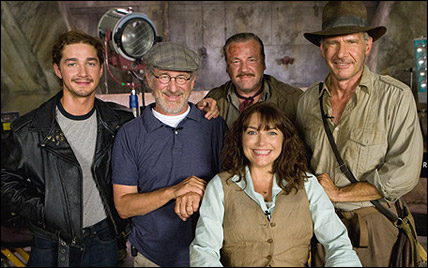
Indiana Jones and the Kingdom of the Crystal Skull has many reasons to be a great movie. Spielberg, or course. It’s also got John Hurt and Ray Winstone it in. And for a movie star, I don’t think Harrison Ford is a bad actor. On the less positive side is the involvement of George Lucas. I’m really sorry, but Mr Lucas should never be allowed near films. Steven, didn’t you notice what a balls up he made with the Star Wars sequels? (okay, I know they were prequels, but I like to deliberately annoy Star Wars fans). And anyway, unless you are aged five the original Star Wars is a really bad film. So the partnership with George Lucas always made the Indy films my least favourite of Spielberg’s popcorn stuff.
From what I’ve read and heard, Harrison Ford’s age at 65 has received much comment. It’s amusing because, when Raiders of the Lost Ark first came out, I remember saying to my friends “did you know that Harrison Ford is about forty?” So he has always been old in my eyes. The film begins by telling the audience loudly that we’ve reached the 1950s and Jones is almost two decades older. In fact Spielberg decides to shout this from the rooftops. An Elvis soundtrack, period cars and costumes, secret army nuclear testing sites – and all before the titles have finished rolling. Indiana Jones is now under the spectre of McCarthyism, not only fighting off Russian baddies but himself suspected of Communist leanings.
The opening scene of the film is very impressive and Spielberg and Lucas cleverly won me over with little effort. Cate Blanchett as a heavily accented villainess, Ray Winstone in top form as a greedy turncoat and some excellent magnetic tomfoolery involving Roswell alien artefacts. It never really slows down from there. More reminders of the fifties before Spielberg bores of the attention to detail, including an homage to Brando in The Wild One, lead us swiftly into more familiar Jones territory. Cobwebbed caverns, skeletal remains, treasure, stone passageways and the rest. It’s really another collection of terrific bits, but they are all superb. Very hungry ants, an exhausting car chase, disappearing spiral staircases … but it’s purely a visual feast and beyond description.
Performance-wise it’s good too. As mentioned, the excellent Winstone, and John Hurt delivers the really barmy role that’s been missing from his career. Ford carries it off rather well, and the family business that’s introduced is much less of a drag than I would have thought. Jim Broadbent’s there too, as a doddery academic, and, despite some of the criticisms she’s had, I found Blanchett a fine nasty. What’s slightly out of place is all the alien and atomic stuff, although it’s interesting to see Spielberg’s attempts to blend Indy with ET and Close Encounters. And my favourite scene was probably the weirdest, where Jones runs across a fake 50s sleepy town, complete with family mannequins who are populating an eerie bomb test site. If you’ve already seen the film, you’ll agree that they really made those old American fridges to last.
So Lucas you’re forgiven, at least for the moment. And Spielberg – as for you, good marks but you’re coasting. And you know it. Is it a good popcorn movie? Yes it is, although we had a big box of sticky sweets shared between yours truly and two nine year olds. And it’s more like that; sticky, sugary with various yet familiar flavours and it will spoil your appetite for more of this kind of stuff for a while. But it was good while it lasted.
Okay, so we were all warned about the second series of Heroes. Even Tim Kring, the series creator, famously apologised for its lack of vitality. But I was willing to cast doubt aside. The first series was so good that the second couldn’t possibly be that bad. Could it?
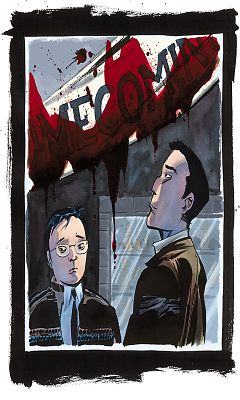
And it started very promisingly – I couldn’t understand what was supposed to be the problem. There were imperfections, some of them laughable, but let’s not forget that the first series had its silly moments too. What’s made me laugh about season two is the lengths taken to strip the most powerful of our Heroes, nasty Sylar and nice Nathan, of their abilities. The point, I guess, is that these two all-powerful characters just had nowhere left to go and convoluted ways of making them vulnerable again were the only option. To recap, Sylar could absorb the super powers of other heroes by doing something horrible and slicing off the top of their heads; Peter could also absorb powers by just, well, saying hello really. In the new series Sylar, lucky to be alive after a nasty brush with Hiro’s sword, is reduced to hitching a ride with some utterly tedious new characters and pulling very nasty faces in an “okay, so I’ve no powers, but I can still look real scary” kind of way. Peter, on the other hand, has simply lost his memory and is reduced to hanging out with some very dubious and unconvincing Irish people who make me quite uncomfortable because I am waiting for them to say “The Pogues, The Pogues”, “Roddy Doyle novel” or “I know a nice pub in Cricklewood”. Peter is reduced to pulling very convincing gormless faces in an “oh, I didn’t realise I could fly or makes things explode” way. He hasn’t lost his powers, he’s simply forgotten all the clever things he can do. And got gormless.
Elsewhere, Peter’s brother Nathan has developed the ability to grow a very impressive black beard. Nichelle Nicholls, Urura in Star Trek, turns up as someone’s gran, nicely complementing George Takei, Sulu in Star Trek, as Hiro’s Dad. Matt Parkman, the mind reading one, went off to meet his own Dad. I was secretly hoping his Dad to turn out to be William Shatner, but unfortunately this wasn’t the case. Mohinda, whose own Dad was bumped off by Sylar in the last series, is still wandering round trying to make sense of it all. He’s still pally with Mr Bennet, Clare the cheerleader’s Stepdad. And so on, into infinity. But still, as yet, no more cameos from Stan Lee to complement the comics theme.
There’s some good stuff though; Hiro’s exploits in feudal Japan are very entertaining, and Nathan and Matt are embarking on a dark story arc of their own. What’s possibly wrong with this series is that it is very literate. It’s like reading a very long, rambling and slow novel. There’s nothing wrong with that – it’s a great pastime – although an odd concept for television to adopt. But I like that; Heroes is daring to be overcomplicated and strange and bold enough to risk losing some of its audience. What I don’t like is it is very, very tedious at times and I’ve even nodded off, which is something I never usually do. Unless I’m just getting old. Hopefully I’ll make it through to season three where it’s rumoured that Leonard Nimoy makes an appearance as Stan Lee. Or something like that…
Previous Page |
Next Page
