Neil Gaiman’s debt to Ray Bradbury as master of the macabre short story made me want to go back and reread a couple of classics.
Bradbury’s world always appears to be on the periphery of what’s comfortable and safe, occupying antiquated fairgrounds and remote shacks on the edges of windswept landscapes. His characters are always just on the edge. The Dwarf is one such tale, using the setting of a hall of mirrors for its disturbing chain of events. The dwarf from a ramshackle fairground finds solace in the mirror maze, visiting night after night. He’s watched by a would-be tormentor, who realises that he is posing in front of a specific mirror, one that alters his proportions to a larger size. The nightly visits always satisfy the dwarf, until a mirror is mysteriously changed and things aren’t quite the same again.
The creepy showground is also the backdrop for The Jar, where a mysterious glass bottle houses something quite disturbing that may be a fake or may be a real and rather sickening specimen. It is real enough to spark flights of imagination in those who gaze at it – we hear of dead infants and drowned kittens – before the story ends with something very tangible taking residence the jar…
These tales date from 1955 and 1947 respectively, but Bradbury is still going strong. There’s a new film version of Fahrenheit 451 in production and there’s always room for a new version of my personal favourite The Martian Chronicles. But these older short stories are always worth a read. And always manage to unsettle.
The imp grinned down at me from the wooden door, a vivid splash of crimson in the grey gloaming.
I walked around to the side of the playhouse and peered through all the windows, one by one, into the dark and empty room. Nothing moved in there. I wondered if the other three were inside hiding from me, pressed against the wall, trying their damnedest to stifle their giggles. I wondered if it was a big-boy game.
I didn’t know. I couldn’t tell.
I stood there in the courtyard of the playhouse, while the sky got darker, just waiting. The moon rose after a while, a big autumn moon the colour of honey.
And then, after a while, the door opened, and nothing came out.
Neil Gaiman’s Fragile Things is a collection of short stories and poems. It is about dreams, fairy tales, children’s games, urban myths and monsters. It celebrates the art of a good story told well, something that Gaiman shines in as a true artist of the ghost story.
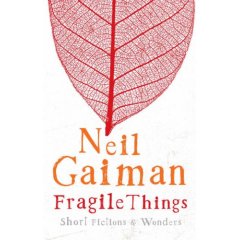
In 26 brilliant parts, this book is almost beyond a review. Subjects include a homage to Conan Doyle with shades of H.P.Lovecraft, a Matrix style sci-fi tale and instructions on what to do if you just happen to find yourself trapped in a fairy tale. And three of the tales were the best short stories I have read in years…
October in the Chair is a tale within a tale. It’s excellently told, and even though it has loose edges this is what can be attractive about Gaiman. He’s unafraid in presenting fragments, stories that are even more chilling in their inconclusiveness. Real scares are not as neatly formed as a comfortable short story. In this story the months of the year take turns in relating ghostly tales. They take a while to settle down, discuss the odd urban myth before a story about a lonely child … and the dearly departed. Fantasy is expertly weaved into this chilling tale, and Gaiman manages to also weave what appears familiar with the truly original.
There are some similarities between this story and Closing Time, from where the opening quote is taken. Visitors to an after hours drinking den in the West End of London again settle into urban legends – one neatly echoing the story from October in the Chair – before embarking on an account of a boys game of dare that becomes mysteriously open ended. It’s effective enough, but Gaiman skillfully stitches on a particularly nightmarish conclusion that keeps just enough back from the reader to truly disturb. He also continues to excel in his Chinese boxes method of storytelling.
Closing Time stayed with me a long time after I’d put Fragile Things down, but my favourite may turn out to be the brilliant Feeders and Eaters, about a particularly hungry tenant in a lodging house, where Gaiman isn’t afraid at all to worry and haunt his reader. The ending made me want to snuggle into my armchair just a little bit more. Then again, I may develop other favourites such as The Monarch of the Glen, about a loner visiting Scotland who foolishly agrees to some unusual overtime…
Fragile Things is such a rich collection that it asks to be read again to be fully appreciated, and Gaiman is a writer that demands to be read full stop. He’s a master that carries the macabre tradition of Ray Bradbury, and comes across as the mischevous twin of Susanna Clarke. Read him – especially as it’s nearly Hallowe’en. My only worry is that Hollywood already has its clutches on Neil Gaiman – I just want him to continue with the short stories that he writes so brilliantly.
Following on from my last post I underwent a spot of detective work to investigate if there were any more ghost stories from the pen of H.G.Wells. And I found a classic. Written in 1894, The Red Room is a superb little tale.
“It’s your own choosing,” said the man with the withered arm once more.
I heard the sound of a stick and a shambling step on the flags in the passage outside, and the door creaked on its hinges as a second old man entered, more bent, more wrinkled, more aged even than the first. He supported himself by a single crutch, his eyes were covered by a shade, and his lower lip, half averted, hung pale and pink from his decaying yellow teeth. He made straight for an arm-chair on the opposite side of the table, sat down clumsily, and began to cough. The man with the withered arm gave this new-comer a short glance of positive dislike; the old woman took no notice of his arrival, but remained with her eyes fixed steadily on the fire.
“I said – it’s your own choosing,” said the man with the withered arm, when the coughing had ceased for a while.
“It’s my own choosing,” I answered.
The Red Room has a fantastic build up, where the old people who warn the narrator against his wishes to visit a haunted room are as creepy as any ghosts he may or may not encounter. It’s the repetition that makes it work, the endless questioning about whether he really wants to go through with this, by his own choosing. I’m putting it in my top ten of ghost stories.
Another gem I found this week was The Coat by AED Smith. Dating, I think, from the early 1930s, this short story concerns a self confessed loner who embarks on a cycling holiday abroad. Escaping a sudden downpour, he takes refuge in an abandoned house. There, he sees small unsettling details. The orange fungus growing across a carpet, strange patterns in the dust and an old military coat:
I discovered that just below the left shoulder there was a round hole as big as a penny, surrounded by an area of scorched and stained cloth, as though a heavy pistol had been fired into it at point-blank range. If a pistol bullet had indeed made that hole, then obviously, the old coat at one period of its existance had clothed a dead man.
Superb stuff, and Cook has the knack of putting the reader right in the scared man’s shoes…
Previous Page |
Next Page
