Each person who ever was or is or will be has a song. It isn’t a song that anybody else wrote. It has its own melody, it has its own words. Very few people get to sing their own song. Most of us fear that we cannot do it justice with our voices, or that our words are too foolish or too honest, or too odd. So people live their songs instead.
Recently I’ve become a fan of Neil Gaiman. His short story collection Fragile Things is a contender for my book of the year and I’ve been subscribing to Neil Gaiman’s Journal, one of the best author blogs I’ve seen. Anansi Boys is the first of his full length novels I’ve had the pleasure to read.
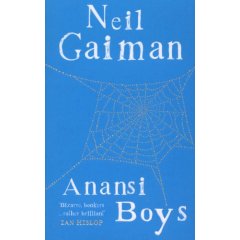
Gaiman in a writer with a distinct style of his own, inventing a world that is always magical and imaginative, and one with a slightly dark edge to it. Anansi Boys follows the adventures of one Fat Charlie who, following his father’s death, foolishly opens the door to his life to Spider, the mysterious brother he never knew he had. Spider proves to be a sibling of nightmarish proportions, bringing annoying aspects of his magical abilities with him. He moves a whole alternative world into Charlie’s spare room and seduces his girlfriend. Just for starters.
Anansi Boys moves between London, Florida and The Caribbean as well as stopping off in other uncharted territories, namely ones invented by the apparently limitless mind of Gaiman. I’ve said this before, but his writing reminds me a lot of Susanna Clarke, who brought us Jonathan Strange and Mr Norrell. He has a similar knack of using the well worn trick of magic in a highly original way. I’m thinking here of the scene where Charlie hails a taxi to take him just a few streets home. The magic weaved by Spider prevents his driver from taking him home, getting more a more lost in just a handful of streets. And Gaiman provides also a very well written scene from the point of view of a ghost.
There are many joys in Anansi Boys. Luckily for me, Neil Gaiman is a highly prolific author, so I’ll be moving on next to Smoke and Mirrors. Can’t wait…
Classic Covers: Frankenstein

You can do anything with Frankenstein. It’s a story that invites a reinvention; it’s always ready to come back and scare a new generation of children. And scare adults again in a different way. I always welcome a new adaptation of Mary Shelley’s classic. Some bear little resemblence to the original, others try to stick too closely to it. Whatever they are, I always enjoy letting the Frankenstein experience wash over me. Whether it be Karloff, Lee or some new pretender – I’ll always be receptive.
Apologies for the poor image of this 1973 Arrow paperback edition of the novel. The cover is fascinating; very 1970s and very little to do with the book really. It could decorate any collection of ghost or horror stories from the period. At a pinch it could illustrate an edition of Dracula. But it’s a great cover nevertheless; candles, a blonde screaming beauty in a nightdress, a three-fingered hand. Things that kept the Hammer movie producers excited throughout their careers.
Frankenstein endured another reinvention this week with a new ITV version starring Helen McRory as Victoria Frankenstein. It is unkind to say endured because I thought this was an excellent take on the tale, introducing a mad (ish) professor and a hitherto untapped maternal aspect to the story. There was something very disturbing seeing Victoria visiting the creature armed with early reading books and baby toys; this gave a brilliant hook to the story that refuses to get tired.
Although my wife dismissed the film as it became increasingly preposterous I lapped it up. As I’ve said, this is a story that invites reinvention, and this version did just that, with McRory portraying a very sympathetic scientist and the monster glimpsed just enough to deliver the right amount of scares.
Frankenstein 2007 received some bad press. Unjustly, I think. Reviews were unimaginative in their slating (come on, the creature wore a hoody – and they missed out all the jokes with that one). But they also missed the point. Midweek tv. Something called Frankenstein and – even though it is a concept first dreamt of in 1816 – it’s still a viewing must.
This latest version of the horror classic washed over me as I knew it would and as I wanted it to. There’s room for more and I look forward to further reinventions.
Abandonment
Thursday October 25, 2007
in books | meme
From Booking Through Thursday:
The books that you start but don’t finish say as much about you as the ones you actually read, sometimes because of the books themselves or because of the circumstances that prevent you from finishing. So . . . what books have you abandoned and why?
If I could define a meaning for the expression that sinking feeling it would be the mood of resignation I fall into when I abandon a book. When I start something I feel obliged to finish it, especially when I’ve had such high expectations. This year I have abandoned several highly acclaimed novels. Why is this? Is it me? Snow by Orham Pamuk was an early casualty, followed by The Plot Against America by Philip Roth. There are others, but I feel ashamed to mention them. And these are just recent novels; that sinking feeling becomes that sunk and underwater feeling when I give up on a classic. A Tale of Two Cities did nothing for me, and neither did Sense and Sensibility. Visitors sometimes comment on the rich selection of books on my shelves. They do not know that some of them are abandoned…
I excuse my behaviour as natural spillage. After all, I do read a lot so some books will get left by the wayside as I journey on. There comes a point where you have to give in to your instincts. Snow had some great reviews, some from fellow bloggers, but I was peering over the pages and looking at the next book on the top of my pile and dying to read that. And when that happens it’s time to give up. With Philip Roth it was a similar experience, but my treatment of classics is less easier to explain away. I think I have perhaps become a little lazier in my reading, and possibly subconsciously relate the harder books to being a student. Reading becomes as task rather than a pleasure and I’m compelled to make pencil jotttings in the margins of my Dickens and Austen…
Previous Page |
Next Page
