Merry Christmas, Mr Dawkins
My copy of The God Delusion by Richard Dawkins boasts the subtitle “the alternative Christmas gift”. Borders took the joke one stage further by sticking a card inside the cover which reads “oh come all ye unfaithful”. I’m sure Mr Dawkins won’t mind the joke. Reading him, it’s obvious he does have a sense of humour, although my approach to the book isn’t really to seek an alternative Christmas gift or message, or to declare myself unfaithful or not. I like a well written, intelligent book and I like a good argument. Richard Dawkins provides all of this for me.
What surprised me is that The God Delusion isn’t just the anti-God polemic that I’d been suspecting, the book that its critics have been ranting about. Dawkins prints some of the abusive letters he has received since its publication, damning him in no uncertain terms, and letters no doubt from people who haven’t bothered to read The God Delusion. The same mentality that led people to burn copies of The Satanic Verses. Dawkins certainly knows his theology, I would say more so than many of his critics, but his well considered book touches on science in discussing how the universe came to be, Darwinism in how we came to be, gene theory in how we came to be like we are and meme theory in how we came to think and act like we do. Yes, you meme-loving bloggers out there, Richard Dawkins is the one who originally coined the phrase meme in 1976.
So at times, and what I found very rewarding, is that The God Delusion serves as a kind of Richard Dawkins Greatest Hits, covering many of the topics he has written about at length in his other books. But be warned. Although he does cover themes such as natural selection (one of his favourites), he expects you to have some prior grasp of them. This book isn’t another A Short History of Nearly Everything by Bill Bryson (although that’s a book that serves its purpose well), and if it was it would be four times as large. This is a writer who respects the intelligence of his reader, and Dawkins supplies a rich resource of references to follow if you should see fit, from texts similar to his own (there are several books specifically about meme theory) and links to websites. He even quotes a comment to a blog post that he’s found insightful.
The God Delusion isn’t a book that will change my life because I don’t need to be converted to Dawkins’ argument, but it isn’t a book that will only succeed in preaching to the converted either; it is a clever, extremely well researched book that should be read by any intelligent person. And anyone who condemns it unfairly without a good counter argument deserves to be labelled ignorant. And ignorance is one of the things that really annoys Richard Dawkins.
Books of the Year: Part One
Tuesday December 11, 2007
in books | reviews
The time has come again to trawl through the best books of the last twelve months. I’ve divided my choices into several categories. The first two cover new fiction.
Brand New
I’ve bought an alarming number of hardbacks this year. Reading books hot off the shelves is increasingly addictive. Right at the beginning of the year I enjoyed The Thirteenth Tale by Diane Setterfield. This is a novel I expected to receive more coverage. It’s very well written with some fine gothic undertones. Also recommended highly are two nominees for the 2007 Booker. Ian McEwan’s On Chesil Beach and Darkmans by Nicola Barker. We all know about the first, although the second is another book sitting in unfair obscurity. Worth picking up if you have the strength and stamina for its 800 plus pages. Incidentally, I found the eventual Booker winner, The Gathering by Anne Enright, tedious and unoriginal. What were the judges thinking of?
The best book of the year to grace my presence was The Road by Cormac McCarthy. It’s uncomfortable, harrowing, profound, frightening. It’s a masterpiece. Most importantly, it’s a book people will still be talking about in ten, twenty years time.
Lastly in this section, if you do have any Christmas money left over, I’d suggest Engleby by Sebastian Faulks. Quite different to anything else he’s written and very, very good.
Nearly New
My pile of newly released paperbacks of 2007 has reached toppling height, although there are only a few I would recommend highly. Again, some of them are criminally obscure. The Testament of Gideon Mack by James Robertson is an unsettling yet gripping book about a man who may or may not have met The Devil. Fantastic.
Less obscure is The Tenderness of Wolves by Stef Penney, a novel that’s received divided responses, at least going by the comments I received for my review. But I found it an absorbing and original read. However, my favourite paperback of the year by far was Neil Gaiman’s Fragile Things. This is a collection of supernatural stories that is well written, wry, highly original and, most importantly, scary.
Sadly, it was the books that received too much attention that disappointed the most. Don de Lillo’s Falling Man, Jed Rubenfeld’s The Interpretation of Murder and, I’m sorry to say, the final Harry Potter took up too much reading time that that would have been better spent on something more worthwhile. Here’s to 2008.
As somebody who has spent a lot of idle time watching most horror film of the 60s and 70s, House of Whipcord has always passed me by. Made in 1974, it’s such an obscure film that I don’t recall it ever being shown on UK television. It took a recent bout of ‘flu and Amazon DVD rental to get it to fall into my hands.
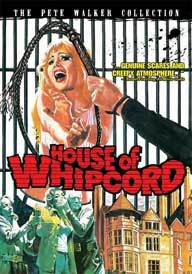
I suspect that one of the reasons that House of Whipcord hasn’t been seen much on television is because at times it is laughably so low budget. Directed by Pete Walker, who also directed Tiffany Jones – the film based on a Daily Mail cartoon – the cast is full of unknown, and particularly weak, actors. The only faces I recognised were Celia Imrie, usually starring with Victoria Wood, and Ray Brooks, most recently seen as Pauline Fowler’s husband (and murderer) in Eastenders. The film features the amount of mild nudity you would expect in a British “X” film of the early 70s, but unlike the lavish Hammer costume dramas of that era, House of Whipcord appears to be filmed on a whipround from Walker’s local pub.
The film concerns a house that has been set up as a private “correction centre”; girls are kidnapped, imprisoned and punished by wardens who could give Prisoner Cell Block H a run for their money. If you don’t tow the line, it’s three shots and you’re out in the House of Whipcord. First punishment is two weeks of solitary in a rat-infested hole, second a serious lashing and it’s curtains for the third. A young French model (Penny Irving) is taken for Correction, with nasty results, although her pretend accent is so absurd that it’s difficult to sympathise with her.
It’s difficult to get through this film; it’s partly hilarious and partly disturbing. You need to shift down into the right gear, and I was crunching the clutch for ages before I found it. Walker’s message is that taking the law into your own hands will lead to crazy results. He still gets that message across. A bit more thought and budget and this could have been a truly great film. Instead, it’s little more than an oddity, but many of the scenes have a chilling and worrying inevitability about them. And it does lend itself to the dare of the best horror films. The main character doesn’t always get away…
Still worth watching for the terrifying Sheila Keith, who appeared in Walker’s other 1974 film Frightmare, Patrick Barr as the decrepid and blind chess-playing judge, and Ray Brooks’ half-hearted acting, totally unconcerned that a friend of his is about to be murdered:
“Excuse me, is there a prison round here, a sort of house of correction?”
“No, sorry”
“Okay, thanks!”
Previous Page |
Next Page
