Made in 1974, Black Christmas is a particularly nasty US horror. Coming a few years before Halloween, it looks like John Carpenter made copious notes after seeing this film before he went on to make his better known classic. Many of Halloween‘s most remembered themes turn up in Black Christmas. The seemingly safe sleepy neighbourhood, the ruthless maniac, the college kids who get more than they bargained for, inept police officers, the disturbingly open ending – this film appears to set the blueprint for every horror that’s followed since the mid 70s.
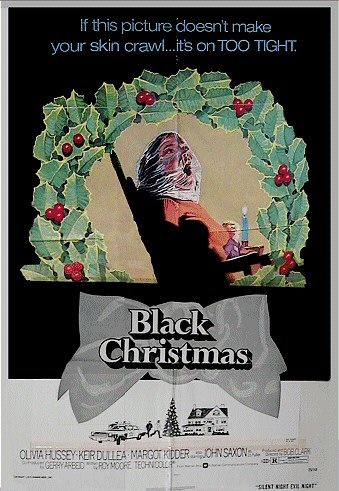
Black Christmas was shown recently on Film 4, but it’s unlikely you’ll see it on any of the more mainstrean channels. It’s a little too blood curdling and there’s strong language that’s still shocking today. A young girl is terrorised by nuisance phone calls. The police attempt to trace them, telling her to keep the menace talking for as long as she can while an expert chases around the local telephone exchange trying to discover where they are coming from. They eventually find out – the calls are coming from inside the house and the madman is revealed to be camping out in the attic. (Incidentally, a plot stolen by a later and another better remembered film called When a Stranger Calls).
Unlike Halloween, there’s no comfort in the fact that the monster might be something supernatural and unworldly – something that isn’t really out there. Black Christmas features a very real and ultimately more disturbing killer. The bogeyman is there alright. Worth catching for horror completists, and to see Margot Kidder in a pre Superman role. The film was remade in 2006 (as was When a Stranger Calls), but the remake disappeared without trace. Accept no imitations.
Christmas Wrapping
Monday December 24, 2007
in |
Christmas festivities have already started in our house, but I’m hoping to find some time to dip into The Book of Lost Things by John Connolly. This is an intriguing novel set in 1939 about a lonely young lad and his love of books. Connolly’s style is almost childlike but his writing is deceptive. It’s quite a dark study of fairy tales and the fears deep within us all. I’m only a few chapters in, but I think it might become a late addition to my books of the year.
But mostly I’m preoccupied with food and drink, especially how the tv chefs appear to shape our lives these days. I’ve been mulling over Heston Blemenfeld’s secret recipe for mulled wine. How does he make it so one half of the glass is hot while the other half remains cold? There’s also Jamie Oliver’s mince pies to think about, and this year I’m following Nigella’s advice and roasting the potatoes in goose fat. The success or failure of the technique in my hands could make or break our Christmas dinner.
So Merry Christmas to all – and thanks for reading, commenting and making it fun.
Christmas Ghosts: The Treasure of Abbot Thomas
It is a thing of darkness.
This short story by M.R.James was immortalised in 1974 by the BBC’s Ghost Story for Christmas adaptation directed by Lawrence Gordon Clark. This year the BBC are proudly showing a selection of their James adaptations, although this one is repeated with alarming regularity. But I’m grateful – The Treasure of Abbot Thomas is one of the most satisfying ghost stories I’ve ever seen.
Or read. After watching it again the other evening I was tempted to reread the original short story so I could sit down and conduct a compare and contrast exercise. Interestingly, the two are quite different, and John Bowen – who wrote the television screenplay – has reworked the story quite dramatically. Where the original ends quite comfortably, perhaps something welcome for a 1904 Christmas, the film has a particularly chilling ending to it. More suited for the 1970s, still apt for today’s audience. Very apt for my tastes – I must confess that I prefer the film more.
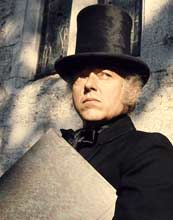
The Treasure of Abbot Thomas (1974). Are you sure you really want to go ahead with this?
The story follows Mr Somerton, an antiquary who attempts to unpick a code that is scattered in various places by the late Abbot Thomas. Somerton unravels the mystery that leads him to the Abbot’s gold, with supernatural consequences that lead him to return it to its hiding place as soon as he possibly can. It’s a classic James warning to the curious, but with mostly harmless results.
Bowen and Clark’s film casts the excellent Michael Bryant as Somerton. One of their embellishments to the tale is to show him as a firm disbeliever of anything supernatural. All the more to prove him wrong as the story unfolds. Somerton is seen exposing a charlatan at a fake séance. He pursues Thomas’ scattered clues purely as a keen researcher (it’s an interesting puzzle to him, something of a Victorian sudoku), and seems oblivous to the sinister monks who creep around the church where he carries out his studies. But although possibly an intellectual giant, Somerton is weak of the flesh. Climbing to the church roof to pursue his leads he is overcome by vertigo and almost topples to his death. Discovering that the treasure is entombed in an underground crypt, he can only just control his trembling frame as he wades through the flooded tunnels to claim his prize.
And – and this is the heart of all James’ stories – this is where it will always go catastrophically wrong. After he has retrieved the treasure of Abbot Thomas, Somerton is reduced to a jabbering wreck, ranting about the thing of darkness that tries to break into his rooms. A spell has been cast. No choice but to put it back…
Where I think this film succeeds is in its dark ending, one that has continued to haunt me over the years – with or without repeated viewings. As the now recovering Somerton, convalescing in a country garden, is left in his bath chair to greet his doctor as he strolls towards him we notice from Bryant’s horrified face that something is very, very wrong. The figure that approaches is hooded and swift. It’s approaching to claim its victim. The curious has been warned, but there’s still no getting away with their audacity. Somerton is unforgiven. There’s one last terrifying shot of the petrified antiquary meeting his cloaked nemesis before the closing credits. We see one final glimpse of him before he is taken.
In my youth, I remember climbing the stairs to bed but leaving the lights on after I’d watched The Treasure of Abbot Thomas. The other night I did the same.
Previous Page |
Next Page
