3 Stars
Since closing the last page of Cold Mountain I’ve been considering quietly forgetting this book, leaving a small gap and then swiftly moving onto the next. Charles Frazier’s novel was highly recommended to me, both by fellow bloggers and by friends. The problem I had wasn’t obvious at first, but then it was clear, vivid and eventually spoilt my enjoyment of the book.
My problem was Cormac McCarthy. Just when I decide to leave the author alone for a while I pick up another writer who is so clearly influenced by him that it hurts. What stopped me from enjoying Cold Mountain was the realisation that – take McCarthy out of the equation – and you have no book. In fact never before have I found one writer to be so heavily influenced by another. Frazier copies McCarthy’s unique writing style to the letter, the landscape, the detailed descriptions of chance encounters, characters careful preparations of food (where every meal could be their last), despicable individuals you can’t help liking (Veasey) – and the senseless deaths. And the style of dialogue – the ironic humour – the characters asking themselves what they aim to do – is all McCarthy.
Sorry to be like this. There is a great novel in there somewhere, but reading Cold Mountain was like listening to an Oasis album. Okay, but it’s been done before – and better. Cold Mountain is the best novel Cormac McCarthy never wrote – and I can guarantee someone’s already said that before.
4 Stars
I do not know what you are expected to do with memories like these. It feels wrong to want to forget. Perhaps this is why we write these things down, so we can move on.
Mister Pip by Lloyd Jones is about the effect that Great Expectations has on a particular individual. Appreciation of Dickens’ novel is preferred but not essential to read Mister Pip – it is about how a book can shape our lives in how we make sense of our own place in the world when we compare it to fiction, and about how others may choose to interpret a book for us and how we might come to find the faults in a story. Any story – told well or badly. It might not be Dickens for everyone, but I think we all have books that has made such a mark on us. Or even stories told to us by the forgotten.
On the South Pacific island of Bougainville in 1991, a vague yet threatening war casts a worrying shadow. Mr Watts, also known as Pop Eye, assumes the role of school teacher in an attempt to keep normality flowing. He has only only one text book to hand – Great Expectations. He invites the locals to provide improvised lessons to fill the gaps; the rest of the time he reads Dickens to his class. Mister Pip is in turn narrated by Matilda, who becomes fascinated by the world of Pip, Magwitch, Estella, Miss Havisham … and Mr Watts. As she grows older she turns from Dickens student to scholar, and along the way the narrative also turns – from well observed humour to darker meditation on human cruelty.
What I liked most about Mister Pip was the subtle charting of Matilda’s maturity. It’s not education that saves her – Mr Watts can’t provide education in the conventional sense – but the wisdom she gains as an observer. Fiction from a child’s point of view doesn’t always work, but Jones manages to pull it off. So much so that I didn’t question this voice of a young girl, ready to consume the world but instead facing terrible tragedy.
For a slim work, Mister Pip has great depth. The mystery of Pop Eye’s history is slowly unravelled for Matilda, and through his eccentricity and sadness she does, oddly, learn a lot. This made me think about my own teachers and how, quite frankly, useless they were in the great scheme of my life. Sometimes the oddest characters we encounter can teach us the most. Whether the classic, like Joe Gargary or Philip Pirrip in Great Expectations, or the forgotten, like Mr Watts.
A book to be treasured.
Country of the Blind
Monday January 28, 2008
in 2008 cinema |
5 Stars
At what point would you quit looking for your two million dollars?
So asks Llewelyn Moss (Josh Brolin) at the start of Joel and Ethan Coen’s faithful and stunning adaptation of Cormac McCarthy’s novel No Country For Old Men. This is a thoughtful and compelling film, set in an increasingly violent Texas and Mexico of 1980, and one that deserves all of the praise it’s received as one of the Coen’s very best.
Moss is a man who can’t resist temptation, and stumbling across the bloody aftermath of a drug deal gone horribly wrong he decides to snatch the case of money he finds amongst the bodies. But he is blind to the true mess he has placed his family in; he can only keep running – from one seedy motel to the next as a psychopath called Anton Chigurh effortlessly hunts him down for the cash.
Although the Coens begin their film with a mournful voiceover and shots of a desolate and unwelcoming landscape, the cat and mouse game between Moss and Chigurh begins before we’re fully settled into our seats. Brolin is impressive as Llewelyn but it is Chigurh who shines in this film, played brilliantly by the Spanish actor Javier Bardem. Cool and precise, he’ll remorselessly disperse of whoever gets in his way, in one memorable scene lifting his boots whilst sitting comfortably and talking on the telephone to avoid spoiling them in the rising pool of blood from one of his victims. This really is a character you wouldn’t want to get on the wrong side of – he has a skewed and insane sense of justice that can’t be swayed, a law where fate is decided by the toss of a coin, and where innocent parties become accountable and ultimately doomed.
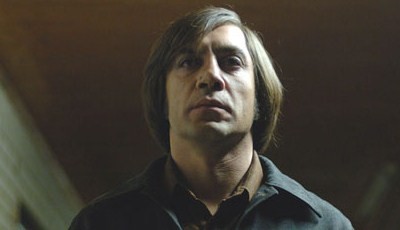
Bardem’s dark assassin contrasts neatly with the tired and laconic sheriff Ed Tom Bell, our opening narrator, played with a wise authority by Tommy Lee Jones. Where Chigurh is blinded by his own imaginary justice, Bell wants to escape the role justice has thrust upon him. He really can’t see where the bloody chain of events caused by Llewelyn’s foolishness will end, but at least will admit this. He’s not blinkered like the other three male leads (the third being Woody Harrelson’s over confident bounty hunter). An old man in an increasingly unfamiliar country, Bell wants to quit while he still can.
Where in my mind the Coen Brothers have been slacking in recent years (I think their last truly great film was The Big Lebowski), No Country For Old Men puts them back at the top of their game. And to their credit, they make little change to McCarthy’s original. This is a bold move, as where the novel more easily went against convention this is more difficult to achieve gracefully with cinema. The audience I was part of were perplexed at the film’s downbeat end, it didn’t go where they were expecting it to go and, where you can put a book down to ponder on its inconsequential narrative, films do make you want a more conventional ending. At least until you think about things later. Things in this film don’t tie up neatly, but I was left comparing the different perceptions of justice in Bell and Chigurh, and making the more difficult decision of whether Moss should have got away with the money – or not. It’s for you to decide when you see it, but don’t expect a happy ending.
The dialogue in this film sparkles, it’s probably closest to Fargo in this respect, although much of it is lifted straight from the novel. The Coens have done nothing wrong here, McCarthy writes wonderfully realistic dialogue, and they exceed in bringing the novel to life – enhancing rather than changing. Many of the book’s backdrops, the Mexican border, the hotel rooms and violent shoot outs – even the pharmacy where Chigurh makes a spectacular diversion – were exactly as I’d imagined them. It appears such an effortlessly made film, but I suspect that giving this impression is where greatness lies. And like the best Coen Brothers films, each and every performance, from major to minor character, is excellent. Without these touches some of the scenes, such as the memorable and uncomfortable exchange in a garage, wouldn’t nearly be as powerful.
The toss of a coin, the choices of the wise and the foolish, those who unwillingly become accountable and die, No Country For Old Men is a brilliantly subtle movie, miles above the type of film where, in an alternative and less realistic world, Llewelyn Moss would have got away with it.
Previous Page |
Next Page
