The Curse of Galton and Simpson
The BBC are currently showing a short season of dramas about much loved heroes of British comedy, with an emphasis on television stars who had a bloody hard time of it in their personal life. The first film, The Curse of Steptoe, followed the careers of Harry H.Corbett and Wilfred Brambell – stars of Steptoe and Son, arguably the best comedy series ever made which ran between 1962 and 1974. For me, Steptoe and Son took the hardest premise for a television series and ran with it. A small set, two main characters trapped in their horrible lives and constantly arguing. A life with no escape. Old man Steptoe, disgusting, decrepid, selfish but oddly compelling, and his depressed son Harold, still living at home although fast approaching middle age; a wasted life with alternatives always beyond his grasp. Similarities between the Galton and Simpson scripts have been made with Pinter and Beckett and they are worthy ones; the writing is often exceptional – the comedy always shrouded in the bleak and inevitable.
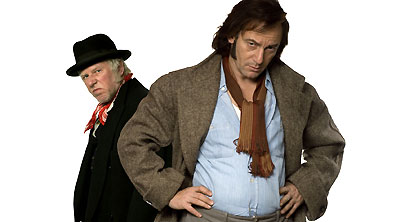
In The Curse of Steptoe, Harry H.Corbett (played brilliantly by Jason Isaacs) remarks “it’s like Waiting for Godot, although Godot never bloody comes” when waiting for the perpetually late Wilfred Brambell (Phil Davis) at an early read through. Corbett, a highly regarded British stage actor in the early 1960s who was mentioned in the same breath as Albert Finney and dubbed the British Marlon Brando, is enticed by the brilliance of a Galton and Simpson one-off television play, against the better judgment of his theatrical peers, including the director Joan Greenwood. The writing team, who’d enjoyed great success with Tony Hancock, were looking to escape from the shackles of situation comedy, but all are quickly sucked into the even greater success of Steptoe and Son. The series rolls on and on, the writers falling slowly into despair as the situations are exhausted, and the actors into the grim realisation that they will never escape their celebrated creations. The stars are seen having lunch over the years in the BBC bar, their early enthusiasm turning to the frustration over wasted lives worthy of the on screen father and son. The final bar shot sees them seated in drag, showing how stretched and uninspired the situations had become.
Phil Davis was a slight disappointment as Wilfred Brambell/Albert Steptoe. Although he looked the part, he failed to fully capture the physical weakness and vocal mannerisms of the man. I’d always imagined a well turned out gent (akin to the role he played opposite The Beatles in A Hard Days Night) who scrubbed down well to play the dirty old man of Shepherds Bush. Davis seemed to fall somewhere in between. Jason Isaacs, however, was outstanding and as well as delivering a spot on impersonation of Corbett, his sometimes very odd vocal delivery, added depth to a frustrated and not wholly likeable man. Neither revelled in the lives of laughter expected from the stars of sitcom. Brambell was a boozy homosexual, haunted by his failed marriage and subsequent arrest for soliciting himself in a public toilet. Corbett, also drawn to the booze in later years, also looked back on a failed marriage and an unfulfilled career. One of the most uncomfortable scenes in Steptoe and Son is where Harold tries and fails to become an actor, feebly recreating the famous contender scene from On the Waterfront. The British Marlon Brando he would never be.
An exceptional film, The Curse of Steptoe appears to be ending happily before whipping the carpet from under your feet. Corbett, having become a father himself in a new relationship, takes Brambell quietly to one side and they agree to finally quit their roles. Brambell is seen fleetingly in a new relationship of his own with a young man. But just as it’s all looking rosy, and just when you’re thinking “didn’t they get back together again for a final tour of Australia?”, we see Corbett in the final scene, already finding it difficult to find work post-Steptoe, receive that fateful phone call… Like the bleakest of situations for Harold Steptoe, there really was no escape.
3/5
Another view of a ruined London in a distant future. Like Will Self’s The Book of Dave, J.G. Ballard’s 1962 novel The Drowned World also considers a vastly changed city. With global temperatures soaring, London is drowned by advancing waters as giant alligators, snakes and other primeval nasties slither into view to reclaim the world. A band of scientists decide to stick around, charting the changes to a just about recognisable landscape of submerged department stores and tower blocks. Where Self uses modern landmarks to sketch out his future – the wheel on the South Bank features prominently – Ballard has his cast seeking refuge at the top of tall buildings, and the Planetarium – perhaps a more potent symbol in the early 1960s of Man’s imminent conquest of the stars – is reduced to a dark and menacing underwater cavern. The celebration of outer space becomes trapped in inner space, explored by divers in space age protective suits.
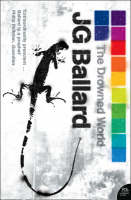
The Drowned World is a well written science fiction novel, but I was disappointed by its lost opportunity to exploit the landscape of London just that little bit more. The premise reminded me of one worthy of H.G. Wells, but – like the devastation in War of the Worlds – the Master would have relished in the chance to describe the city, district by district, as it was claimed by the sea. Ballard also doesn’t delve deeply into why this ecological disaster has occurred; it’s a natural one caused by solar flares (or something equally vague), rather than Mankind bringing it upon himself (he fails to predict the concerns of climate change that a modern novel would eagerly seize upon). Ballard’s interest lies in suggesting human degeneration, something that would have certainly interested Wells. Deep within us all lie fears of the primeval swamp, an innate terror of the reptiles and insects that lived on the Earth millions of years before us. As London is engulfed in water and rising temperatures, these fears also rise in Ballard’s cast – making interesting reading as they slowly succumb to nighmare and madness.
All these years on, The Drowned World survives as a worthy effort to produce a celebral and quality science fiction novel, a hard objective in the sci-fi weary world of the early 1960s. Maybe because of this Ballard treats his subject a little too seriously, there’s room for humour in even the most inhospitable of landscapes – at least on the page. There is also an uncomfortable shift into Heart of Darkness territory towards the end of the novel; an unwise move as it will always be impossible to emulate Conrad. But The Drowned World does have an effective ending, and it’s worth reading, especially as its author had boldly chosen to stick with a genre unfashionable at the time. Admirable.
4/5
At night Dave worked the mainline stations – Victoria and Paddington mostly. The west of London felt warmer in the winter, better lit, less susceptible to the chill of deep time. The fares were frowsty under the sodium lamps. In the back of the cab they slumped against their luggage, and Dave drove them home to Wembley, Twickenham and Muswell Hill. Or else they were tourists bound for the Bonnington, the Inn on the Park or the Lancaster – gaunt, people-barns, where maids flitted through the lobbies, cardboard coffins of dying blooms cradled in their arms. In the wee-wee hours he parked up at an all-night café in Bayswater and sat reading the next day’s news, while solider citizens lay abed waiting for it to happen. His fellow night people were exiguous – they wore the faces of forgotten comedians unfunny and unloved.
Will Self’s novel follows the mental decline of a London taxi driver called Dave Rudman. Seperated from his wife, estranged from his son, Dave slips further into a bleak and confusing world. Reality takes a very weird detour and, when broken, raving and wired on anti-depressants, Dave decides to write it all down. And he doesn’t come near to imagining the legacy he’s creating. Five centuries later, with London flooded and largely unrecognisable, its degenerate citizens worship a new Bible. A book found amongst the remains of the forgotten past – The Book of Dave.

The Book of Dave is a challenging yet compelling read. I was daunted at first by this lengthy novel and came close to abandoning it more than once. It wasn’t until I was at least a third of the way through that it began to grip; I was gripped by Self’s sheer inventiveness, his gift for language and his imagination. It’s one of the most difficult books I’ve read for a while, but Will Self is a highly original and bold voice. As the chapters alternate between Dave Rudman’s sorry life, his decline chronicled between the late 1980s and early 2000s, and the dreamlike future, the reader is given no easy task in making sense of this novel. But if the future chapters are at times unfathomable, they serve well as a nightmarish echo of the present day story. And for me, the contemporary setting worked the best. At first I found Self’s writing grimly reminiscent of Martin Amis’s approach to the city in London Fields; an over the top and detached view, but he soon surpasses any comparison with Amis and reveals what a distinct, mature and gripping talent he has become. And a great London writer – his view of the city is original, romantic and disturbing. And in my mind accurate – he knows his London.
Where in lesser hands The Book of Dave would result in a pretentious and unreadable mess, Self manages to pull it off. A great writer, an infuriating writer. At times I was genuinely moved by this book, and doffed my cap to his skill as an author. At other times I was screaming at him to cut the incomprehensible chapters and get back on track. But that’s Will Self. To get him, you’ve got to love him and you’ve got to hate him. But you can’t ignore him.
Previous Page |
Next Page
