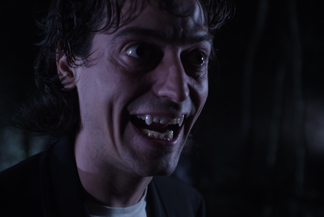
There’s been talk of a new Hammer horror film for some time. Almost a year ago I heard wind of something from the BBC but I didn’t get too excited about it. Now it’s official, but you won’t be seeing anything in the cinemas, or even on television or DVD, just yet. Hammer’s latest official production, their first for nearly a quarter of a century, is exclusive to Myspace. Beyond the Rave can be enjoyed in episodic form and the first few instalments (of twenty) are already available to watch.
A word of warning before you skip the rest of this post in your rush to go and watch Beyond the Rave: it’s probably easier to revive Dracula and Frankenstein from the dead than find your way around Myspace. I’ve always found it almost impossible to find anything on this site, let alone successfully log in. Particularly irksome is the “you can’t do that right now” message if you accidentally enter the wrong password, the endless loops you find yourself going round and the amount of bloody times you have to supply your date of birth. And they don’t tell you that this will only work in Internet Explorer, and that you’ll need Flash 9. And an awful lot of patience, with ideally a PHD in obscure Javascript error messages.
However. My expectations were quite low for this, but I found myself pleasantly impressed with what I’ve seen so far of Beyond the Rave. Those expecting the innocent charm of the Peter Cushing and Christopher Lee era will be disappointed, possibly offended. The new Hammer offering has a modern day setting and resembles (at least in spirit) the Hammer House of Horror tv series from 1980. But that was almost 30 years ago, and the web-only platform for Beyond the Rave means they can do pretty much as they like in terms of language, violence and sheer nastiness, although it still feels weirdly dated (do people still go to raves?). But don’t watch this clip if you’re easily shocked (of course you will, that’s like saying “don’t go down into the cellar” to an eager character in a horror movie).
The plot is quite dense and confusing, which suits the episodic format, but in summary it features a very youthful and potentially doomed cast in rural England, although they are a little more street wise than Hammer’s previous attempts at portraying realistic teenagers (look no further than Dracula A.D. 1972). The early episodes are well paced, although it doesn’t look like it will be long before it descends into the mayhem promised in the trailer above.
Personally it would have been much less frustrating for me if they’d stuck the whole of it on YouTube. But I see the reasoning in the Myspace approach – Hammer doesn’t want to have an immediate flop on their hands after waiting nearly thirty years. Although I imagine that Christopher Lee will absolutely hate this, and Peter Cushing will be turning in his grave.
I can’t really explain what attracted me to Bill Bryson’s new biography of William Shakespeare. There are much weightier books I trawled through as a student, and at only 200 pages I wasn’t sure what Bryson’s Shakespeare: The World as a Stage could offer. However, he excuses his brevity by reminding us that Shakespeare the person is largely a mystery; although we know some key facts about his life, the years of his birth and death, who he married, how many children he had and so on, there’s nothing particularly substantial that’s survived history that even begins to explain his genius and enduring appeal. So as Bryson doesn’t attempt to provide an academic study into any of his plays – Bryson’s a man of facts and figures and not poetry and drama (and he’s more likely to tell us how many words feature in Hamlet as opposed to the themes it explores) – he aims to put Shakespeare into context instead, and we learn about London and the world of the theatre circa 1600.
And this period is always interesting to read about. Bryson is particularly keen to relate the grisly torture and execution that befell traitors and heretics, and he’s also keen to report on poor diet and sanitation, the very low life expectancy and of course the recurring visits of plague. He also gives a very good picture of the theatres of the time, how they came to be and what they were used for. For example, while crowds were prepared to stand watching several hours of Shakespearean tragedy (and as far as we can tell greatly enjoy it) they were also happy to watch bear baiting on another day in the same theatre. This is a book that really enjoys explaning just how different and remote the times were. As well as mentioning the well known restraints of the Elizabethan theatre (such as the fact that the female parts were always played by boys), Bryson carefully describes the life of the actors, from the huge volume of lines they were expected to learn (an actor was required to perform great feats of memory, having to keep several lengthy plays in his head – worrying I suspect if he was already cast as King Lear), how they were forbidden to wear the vast array of costumes outside of the theatre, and the penalties for drunkenness, lateness and the more serious crimes of enraging the monarch.
So Shakepeare’s actual personal life, cloudy at the best of times, acts as more of a bit player in this book. Bryson keeps assumption – always the temptation of a Shakespeare biographer – at arm’s length. The gaps in Shakespeare’s life – did he live in Italy as a young man, was he a soldier? – the questions – what did he really look like, how did he spell his name, was he gay, why did he only leave his widow his second best bed in his will? – are treated as mysteries that will never be resolved. Bryson is also prepared to knock him off his poetic pedestal; Shakespeare was lucky because many of his arguably equally talented contemporaries – including Christopher Marlowe – died young. He also dilutes some of the points often made to argue that Shakespeare didn’t write his plays – or at least collaborated – because they showed an unusually detailed knowledge of law and nautical expertise and anyway were just too good for an ordinary chap from Stratford upon Avon who didn’t go to university. Bryson argues that he was just naturally intelligent – bright, eager to learn, naturally gifted, and if he appears well versed in some subjects he’s terrible in others, for example showing an awful grasp of geography. And, most importantly, if the author of the plays was someone else pretending to be Shakespeare – what exactly was the point in that?
Bryson also tackles the much celebrated fact that Shakespeare had an extraordinary vocabulary – the average person today now knows at least twice as many words as the Bard did; although he concedes that it’s what you do with them that matters. And Shakespeare invented an extraordinary number of words – leapfrog, zany, critical, assassination, unmask – and many phrases were either coined by him or first recorded in his work – cold comfort, cruel to be kind, salad days, flesh and blood. More than any other writer, before or since.
This is an enjoyable book but I couldn’t help thinking it was written with the tourist in mind, somebody who might pass the Globe in London whilst on holiday and were keen to learn a little more. There’s nothing wrong in this, and as I’ve said Bryson does give a good portrait of the era that shaped Shakespeare’s work – and without some grasp of the times it’s hard to understand the plays fully (but we’ll never go all the way, and Bryson points out to the reader who might think they know it all that there are just some lines that remain forever incomprehensible). I wanted Bryson to revel in Shakespeare’s lines a little more, I wanted him to prove to me that he loved those lines, to celebrate all the wonderful things that Shakespeare has done for him, but this is too sober a study for that.
But I hope the tourists visiting the Globe buy themselves a ticket as the only way to really appreciate Shakespeare is to see a good production, and you need to know nothing about the man’s personal life. He can remain an enigma, as possibly he chose to do. I can speak from experience – the 2000 Globe production of Hamlet with Mark Rylance was the best thing I’ve ever seen in the theatre. It will be hard to beat.
I was planning on a Doctor Who review this weekend, but I’m so far behind on things that I’ve only just gathered my thoughts together on Torchwood! Besides, I’m still waiting for a half decent episode of the new Doctor Who.
Okay, the second season of Torchwood then. While it was an uneven ride, there’s been some superlative moments. So even if a few episodes were below par I’m still giving it nine out of ten. I love Torchwood because the BBC have delivered something so far absent from our screens; an adult British science fiction television series. Complete with adult themes and even gay characters who don’t scream their sexuality in quite the same way as a lazily thought out last minute addition to EastEnders.
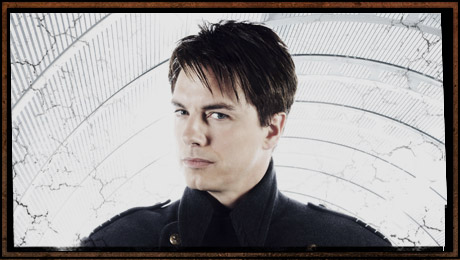
Torchwood is a spin off from Doctor Who, featuring John Barrowman as Captain Jack Harkness, a friend of the good Doctor’s who, after receiving Dalek extermination, is miraculously revived with the ability to regenerate himself (although not quite in the same way as The Doctor – he always comes back to life as John Barrowman). After The Doctor has abandoned him (rightly thinking him dead), Harkness attempts to follow him back to modern day Cardiff. Why? Well it appears that the Doctor frequents Cardiff because there in something called the rift there, which acts as a sort of cosmic fuelling station for the TARDIS. Oh yes, and the BBC base their production there. And Russell T. Davies is Welsh. Anyway, Captain Jack messes up slightly and ends up in 1869, having to wait around for 140 odd years before he runs into The Doctor again to find out exactly what happened to him. Not to worry, he fills his idle hours chasing aliens, being killed and recruiting members of Torchwood, a sort of youthful alien-dealing taskforce. And dreaming that one day he will be absolutely everywhere on UK television, from kids quiz shows to I’d do Anything, the excrutiating Oliver! singalong talent show.
Episodes 11 and 12 are my suggestions for some of the best tv this year. Episode 12 opened with an almightly explosion; four of the five lead characters in mortal danger. Okay, three – as remember Captain Jack Harkness can’t actually be killed. No, hang on – two – as Owen is already dead. A sort of walking dead. Still keeping up? This episode was great as it served as a Torchwood origin, delving back into the past lives of the main characters as they lie semi-conscious and dreaming. We see how cocksure Owen, the bookish Toshiko and the quietly confident Ianto were all recruited (the gorgeous Gwen taking a backseat as we’ve already seen her initiation right back in episode one, series one). Most satisfying was the start of a backstory for Jack’s missing years, showing his recruitment into Torchwood 1899 style, complete with sideburns and a dashing Adam Adamant style cape. Basically, it’s just great fun.
But the series also works well because it is often thoughful and character driven. Going back to episode 11, the gorgeous Gwen becomes involved in some intrigue surrounding a missing teenager who returns – startlingly changed – after a few months away. Some subtle thoughts about loss, motherhood and lost time. I found it oddly moving for a sci-fi show, and equally disturbing, especially the blood curdling scream that people will let out – and one that lasts for 20 hours – after looking into the heart of a dark star (similar to my reaction to I’d do Anything). Moreover, the storyline proved that working for Torchwood might not be the most fulfilling career choice, which was taken one step further in the final episode with the death of two characters (although one was actually already dead, if you see what I mean).
Like its sister show (or perhaps its maiden aunt show) Doctor Who, Torchwood‘s ears are constantly burning with all the idle conjecture that goes on in internet Who chat rooms. Some of the Doctor Who rumours and supposed spoilers are insane – and reading internet forums always spoils the enjoyment of the real thing, spoilers true or otherwise. But the clue is in the name I guess. Spoiler. But it’s inevitable; when recently interviewed by Mark Lawson, Russell T. Davies was proud of the Doctor Who mythology that’s built up since the show was revived in 2005. Its increasing complexity of backstory is all part of his masterplan, and Who fans need little encouragement anyway. Want to take a look? Visit the Doctor Who Forum.
Like Doctor Who, Torchwood has begun to attract quality actors all keen to make cameo appearances, including Ruth Jones from the brilliant Gavin and Stacey, Richard Briers and James Marsters. Marsters plays Captain John, a sort of Master figure for Jack Harkness, although so far less prominent than The Doctor’s arch foe. He’s equally fiendish, charming and very, very dangerous though. The series finale, spoilt slightly for me by the forums, featured exhausting antics you’d expect from anything associated with Doctor Who, including Jack buried alive for nine hundred years or so. Oh well, anything to stop John Barrowman appearing in everything…
I welcome the third series, less a character or two, when it hopefully returns next year. Now onto David Tennant and Catherine Tate…