For some time now I’ve had a mental block when it’s come to Graham Greene’s The End of the Affair. No doubt this is due to the image of Ralph Fiennes’ heaving buttocks from the most recent film adaptation, which unfortunately come to mind whenever I think of the novel. But what Mr Fiennes has done is plant the suggestion of seediness in my mind, and Greene’s novel, both his depiction of London during and after the war, and Bendrix and his snatched affair with Sarah and all that follows really does read as a seedy business.
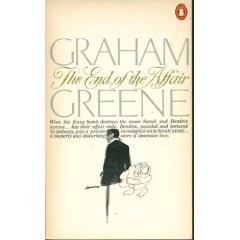
Bendrix narrates the novel, a writer by trade who can well articulate his own shortcomings as a human being. He’s aware of his own bitterness and hatred, but Greene also reveals one of the most arrogant voices I’ve read in a long time. He perches himself far above many of the people he encounters, whether it’s the humble private detective or the betrayed husband Henry. All inhabit a late 1940s world of bombsites, dark bars and darker weather; a setting that’s breathtakingly realistic. But this isn’t why I found the book seedy; it was more the people in it, and all but one of the characters I disliked. In fact the only one I was ambivalent towards, the young girl who Bendrix picks up and takes to Sarah’s funeral, is one of the few that has a lucky escape from him. Of those that suffer, particularly Henry, I tended to share the contempt that Bendrix has for them.
Like many of Greene’s other novels, the subject of Catholicism rears its head. Here, Greene treats Belief and God as something that can be caught, an infection, and just as Sarah contracts pneumonia from the dank London streets, Bendrix fears that he, too, will ultimately believe in God but it will be little more than an unwanted infection. Throughout the book there are also odd glimpses of the supernatural; a skin disease apparently healed by Faith, Sarah’s deal with God that she will not see Bendrix after she thinks he has died in an air raid.
For such a brief piece at 160 pages, The End of the Affair is incredibly dense. It drained me as a reader, and Greene continues to prove that less is more, and that the lesser writer would fail in the temptation to drag out the affair even more. But it’s a painful book to read.
Christopher Petit’s Radio On was made in 1979 and has achieved status as a cult, and extremely obscure, British road movie. Filmed in black and white and featuring a soundtrack including David Bowie and Kraftwerk, it’s a moody and experimental piece that offers a fascinating snapshot of England at the end of that troubled decade.
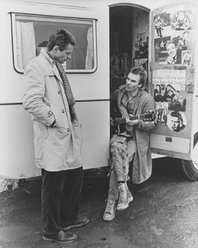
Radio On has escaped my clutches until now, so thanks to the BFI for finally releasing it on DVD. I’ve been interested in catching up with this film for what seems like an eternity; for its acclaimed soundtrack and the use of the twin locations of London and Bristol, my two home towns. The film is probably most well known for featuring Sting in an early acting role, although don’t let that put you off – his performance is far superior to the one in his other 1979 film, Quadrophenia.
Hearing of his brother’s death, a man called Robert (David Beames) embarks on a journey from London to Bristol in his unreliable Rover, encountering several odd characters on his way. A disturbed army deserter (who he wisely ditches by the roadside), a petrol pump attendant (Sting) living in his caravan shrine to Eddie Cochran (who, by no coincidence, died in a motorbike accident on the A4 where Radio On is mostly set), and a mysterious German woman looking for her daughter. Throughout the film Robert appears unable to communicate with others, left in his own thoughts he descends into a drunken spree that leaves him – literally – on the edge.
The snow covered landscape of the South West roads with their seedy filling stations and grimy cafés appears very far removed from the pristine Marks and Spencer Motos of today. Petit’s world is almost an alien one, both from the almost bygone era it represents and for the fact that it is so unlike any other British film of the period. The monochrome shots of the Westway tower blocks look distant and almost East European, and the director does like to dwell on this. There’s also the Kraftwerk tracks and Bowie screaming Heroes in German, and the suggestion that the brother has died as a result of involvement with a European porn ring. But this is no Get Carter. Robert isn’t out for revenge, he isn’t sure what he’s out for at all and the film asks more than it answers. In this way it’s extremely demanding, and what at first appears inconsequential turns out to be a deeply thought provoking look at people stranded in a tired and wasted landscape. As a period piece that looks at Britain on the edge of Thatcherism it’s as good as, if not better, than Stephen Frears’ Bloody Kids.
Yes, there’s an undeniable strange taste to much of Radio On, but it really is a work of art; and the soundtrack is so memorable because it sits so oddly with the film’s content. During the opening scene a camera roams nervously round an empty flat to the accompaniment of Bowie’s Heroes, eventually settling on an apparently dead body in a bath. Workers on a factory shop floor listen to Ian Dury’s Sweet Gene Vincent in a scene that out-weirds David Lynch. Robert lurches drunkenly in a bar to the background of Lucky Number by Lene Lovich and there’s a stunning driving scene to my favourite Bowie song, Always Crashing in the Same Car. Not everyone admires the strange beauty of the Westway or the M4, but you’ll certainly see it in this film. It’s beautifully shot and very, very strange – but well worth a look.
Inspired by Simon’s post I’ve been giving some thought to my holiday reading this year. As I’m currently restraining myself from buying anything new I’m going to find it difficult to pass the airport exclusive stands. Like a smuggler who tries to pass through customs as quickly as possible on the way in to Heathrow, I’ll be dashing past Waterstone’s with my head down on the way out. But I’m determined to keep plundering my existing stock of books.
I’m currently halfway through Cormac McCarthy’s The Crossing. It’s taking me so long to read that I’ll probably be taking it away with me in a couple of weeks time. And if I can stomach any more McCarthy I might also pack Cities of the Plain, the final part of his Border trilogy. Although experience has taught me that it’s wise to leave long periods of rest between McCarthy novels.
This weekend it’s the annual harbour festival in Bristol. Finding the heat and crowds overwhelming yesterday, I excused myself for an hour to find a quiet and shady tree to read by. I noticed only one other reader in my field of vision, a young lady halfway through The God of Small Things. So a chance inspiration for my next title.
The other books will possibly be a choice between The Bone People by Keri Hulme, something else by Joseph Conrad or Graham Greene (often good for holidays). Or I may allow my wife to buy an airport exclusive for me. Which isn’t really cheating.
Previous Page |
Next Page
