Here’s a helping of the gothic, the fantastic and the downright scary. At the Mountains of Madness by H.P. Lovecraft is the story of a particularly disastrous expedition to Antarctica. One group of explorers meet a very gruesome end, whilst a second make some very disturbing discoveries.
It certainly is an effectively chilling story. For me, the opening chapters work the best in how they hint at the horror in the frozen wasteland. Think of having to describe John Carpenter’s film The Thing, but not being allowed to go into gory detail, in fact only being allowed to vaguely suggest what has happened to the alien’s victims. Lovecraft cleverly hints at the impending fate of the explorers; their isolation, the nervousness of their dogs, the very vastness of the unwelcoming landscape:
In the whole spectacle there was a persistent, pervasive hint of stupendous secrecy and potential revelation. It was as if these stark, nightmare spires marked the pylons of a frightful gateway into forbidden spheres of dream, and complex gulfs of remote time, space and ultradimensionality. I could not help feeling that there were evil things – mountains of madness whose farther slopes looked out over some accurse ultimate abyss.
At the Mountains of Madness was rejected by the magazine Weird Tales when it was written in 1931. It’s difficult to see why, as weird it certainly is. But conventional, at least for the time, it isn’t. Whilst the opening chapters sit comfortably in the horror/science fiction genre, the later ones veer off into gothic territory when a second group of explorers unwisely decide to look further. Lovecraft paints a very detailed picture of a vast, ancient and seemingly abandoned city; his description is so vivid that I felt I was walking through its claustrophobic caverns. Creepy and disturbing, but not quick-fix horror.
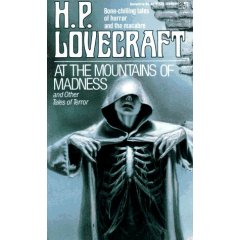
If you haven’t been scared off by the cover art above, it’s from a 1991 edition of the book – described by Amazon as a mass market paperback. You couldn’t find more of a contrast with the cover of a different edition, below, which has more of a connection with the story, showing the foolish explorers travelling into Antarctica by air.
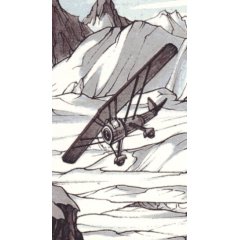
The first cover suggests the quick-fix horror, the second more a Boy’s Own adventure about to go wrong, or a 1930s update of an H. Rider Haggard adventure. A sort of King Solomon’s Mines where no one gets out alive – or sane.
Our room looked over roofs down to where this funny quay crooks into the sea. Gulls dived and screamed like Spitfires and Messerschmitts. Over the English Channel the sticky afternoon was as turquoise as Head and Shoulders shampoo.
‘Ah, you’ll have a whale of a time!’ Dad hummed a bendy version of ‘I Do Like to Be Beside the Seaside’. (The bathroom door’d opened by itself, so I could see Dad’s chest reflected in the mirror as he put on a string vest and the shirt he’d just ironed. Dad’s chest’s as hairy as a cress experiment.) ‘Wish I could be thirteen again.’
Then, I thought, you’ve obviously forgotten what it’s like.
David Mitchell is a writer who has the ability to assume any number of believable and different voices. He proved this in Cloud Atlas, with its array of six seperate narrators that shifts from the 19th Century to a distant and dystopian future. Black Swan Green is far less ambitious with Mitchell adopting one voice for the entire novel, that of a thirteen year old boy.
Jason Taylor lives in Black Swan Green in Worcestershire. It’s 1982. Adolescence and early Eighties Britain is seen through his imaginative eyes; girls, school, friendships and family life. Mitchell scatters references to appropriate television shows and news from the period (the Falklands War casts a large shadow) throughout the novel. Taylor appears a bright lad, he’s recently won a poetry competition. There are, however, things playing on his mind; he suffers from a stammer (referred to throughout the book as Hangman), and he’s constantly conscious of the fragile pecking order that exists in his peer group.
The threat of madness and death looms heavily in Black Swan Green. In one chapter, Jason and his friend stumble across a summer party at a country asylum that is disturbingly cut short, and he has several encounters with other unhinged and potentially dangerous characters. These are usually eccentrics living on the fringes of his comfortable surroundings, such as the larger than life Madame Crommelynck or the band of gypsies he befriends. Jason also constantly refers to children in his school who haven’t quite made the grade when it comes to intelligence, and adulthood is often viewed as a sad, lonely and unfulfilled as personified by parents, neighbours and teachers.
A novel from the point of view of a young male invites comparisons with other recent fiction, particularly The Curious Incident of the Dog in the Night Time by Mark Haddon and Vernon God Little by DBC Pierre. I’m sure there are countless others that I haven’t read in a trail that goes right back to J.D.Salinger. Black Swan Green also reminded me of Bad Behaviour by William Sutcliffe in how peer pressure means everything to a thirteen year old and how the balance can easily change. Mitchell describes each boy’s status as being similar to army ranks, and Jason slips down to the very bottom as the novel progresses.
My disappointment with Black Swan Green came from my expectations of David Mitchell. Cloud Atlas was such a strange and original novel that I was expecting something similar, and the opening chapter of Black Swan Green is fantastic, describing a lake where many children have died in the past where Jason and his friends play on its frozen surface, the menacing phone calls that his parents are receiving and a very odd encounter at a house in the woods. The novel just doesn’t follow this promise and is more content to settle into more familiar territory with everything interesting, the threats of madness and death, only remaining under the surface. It’s not that I expect every novel I pick up to be dark and disturbing, but I do expect this if the opening chapter suggests so, and where there are many references to accidental deaths haunting the book. Ultimately, Black Swan Green reminded me the most of another book set in 1982 and narrated by a thirteen year old boy, The Secret Diary of Adrian Mole. This isn’t a criticism, it’s just not what I expected.
Bullet Points and Winter Warmers
Friday January 12, 2007
in books |
- Patrick McCabe’s Winterwood left me sitting in a stunned silence. Stunned because I didn’t really know what to make of it; the book is well written, dark and very disturbing but I’m not sure what it’s done to me. If anything. It’s still slowly sinking in.
- Possibly because McCabe had left me sitting in a trance, I left it too late to vote in the Seventh Annual Weblog Awards. A shame, because there’s a good few blogs that I’d have voted for.
- To get my strength back I’ve started reading Black Swan Green by David Mitchell. I’m racing through it and will probably feel suitably rejuvenated to give a full review soon.
- Goldfinger by Ian Fleming is proving an easy but enjoyable read. I’d describe this type of book at this time of year as a winter warmer. Bond is portrayed as the killing machine who will ruthlessly dispense with someone who gets in his way. With his bare hands – The original Bond I’ve often heard about. It’s funny, but as I’m reading I don’t think Sean Connery but I think Daniel Craig.
- As I always welcome a complete contrast, I’m enjoying reading the Horrid Henry stories with my daughter. Francesca Simon’s a very witty writer, and Tony Ross is one of the best illustrators around. Contrasts, you can’t beat ‘em.
Previous Page |
Next Page
