The Great Unfinished
Monday March 12, 2007
in books |
Yet another book survey has named the UK’s most put-downable books. Here’s the list of the most unfinished fiction:
- Vernon God Little, DBC Pierre
- Harry Potter and the Goblet of Fire, JK Rowling
- Ulysses, James Joyce
- Captain Corelli’s Mandolin, Louis De Bernieres
- Cloud Atlas, David Mitchell
- The Satanic Verses, Salman Rushdie
- The Alchemist, Paulo Coelho
- War and Peace, Leo Tolstoy
- The God of Small Things, Arundhati Roy
- Crime and Punishment, Fyodor Dostoevsky
Personally, I can’t see a problem with Vernon God Little. It’s overrated I grant you, but I still like it and it’s a slim volume and not that hard to get through. Similarly, if you have a problem with finishing Harry Potter maybe it’s time to go back to junior school rather than sit around completing surveys?
Captain Corelli’s Mandolin is – whether you hail it as a great work of fiction or not – still remarkably lightweight. Who are these people? Probably the ones who waited around for the film versions. In the case of Captain Corelli’s Mandolin it serves them right.
Cloud Atlas I realise may not be everyone’s cup of tea, but I did finish it, although Ulysses and War and Peace still remain on my unfinished pile. I’ve never attempted The Satanic Verses (after abandoning Midnight’s Children) and, although I still haven’t read it, The God of Small Things is the book I pick up most in second hand bookshops and go “hmmm…” before putting it back again.
Perhaps it’s something to do with recommendations, whether from the media or from friends. DBC Pierre’s Booker success may have influenced some people to buy it. It did me. And Corelli is more obviously a personal recommendation, so there must be a lot of offended friends out there, after hearing that their favourite book was abandoned. For the record, here’s five books that I urged friends to read, who didn’t like them and made me sad:
- Catch 22 by Joseph Heller
- London Fields by Martin Amis
- The Catcher in the Rye by J.D.Salinger
- The Remains of the Day by Kazuo Ishiguro
- Vernon God Little by DBC Pierre (bringing us full circle)
You know who you are!
Published in 1959, Titus Alone is the last of the Gormenghast trilogy. It takes up the story of Titus Groan, the seventy seventh Earl of Gormenghast, who has forsaken his title and left the ancient castle walls of his home to embark on a very weird walkabout.
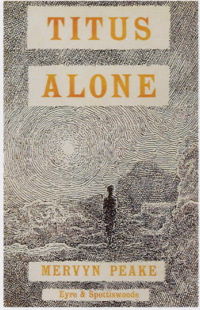
And weird it certainly is. As well as being very different in style and tone, Titus Alone at times inhabits a completely different universe to its predecessors. Where Mervyn Peake’s previous two instalments are set in an apparently pre-technological era, where characters are reliant on natural light and creep around with candles in the night’s gloom, Titus stumbles into an almost futuristic age, complete with space age cars and flying machines.
Titus, exhausted and delirious, discovers an unnamed city beyond the outskirts of his familiar world. In this setting Peake can’t resist introducing more bizarre and eccentric characters, and Titus Alone boasts some of his strangest – such as the zookeeper Muzzlehatch, and the women in Titus’ life, Juno and Cheeta. It’s a dreamlike world, where anything is likely to happen. In the following passage, Titus eavesdrops upon a very peculiar party:
Meanwhile Mr Acreblade was making room for a long-faced character dressed in a lion’s pelt. Over his head and shoulders was a black mane.
‘Isn’t it a bit hot in there?’ said young Kestrel.
‘I am in agony,’ said the man in the tawny skin.
‘Then why?’ said Mrs Grass.
‘I thought it was fancy dress,’ said the skin, ‘but I musn’t complain. Everyone has been most kind.’
‘That doesn’t help the heat you’re generating in there,’ said Mr Acreblade. ‘Why don’t you just whip it off?’
‘It is all I have on,’ said the lion’s pelt.
‘How delicious,’ cried Mrs Grass, ‘you thrill me utterly. Who are you?’
What on Earth is going on? You may well ask. It’s just a very, very odd and outstandingly original work. Just as Titus has forsaken Gormenghast castle, Peake has lost his debt to Dickens for his inspiration. Instead, take a pinch of Aldous Huxley and H.G. Wells, throw them together with a generous helping of Samuel Beckett and Franz Kafka and you’re some of the way to grasping Titus Alone.
This is the oddest of sequels. It has a very post-apocalyptic feel to it (and you can maybe take the near-apocalyptic storm in Gormenghast as a starting point). Recent fiction also owes a debt to Titus Alone, including Martin Amis and Margaret Atwood’s Oryx and Crake. But as a British novel from the late 1950s, the closest of Peake’s contemporaries I can think of is William Golding.
The last part of the Gormenghast saga touches upon experimentation and torture, from the sinister ‘Factory’ to the mind games played on Titus, and Peake’s life was haunted by mental breakdown and illness; he also witnessed the horrors of Belsen first hand as a war artist. Aspects to this complicated man may help to provide a key to Titus Alone – and it’s going to take a good few rereadings before I begin to fully understand or appreciate this novel…
Steerpike was aware, directly he had entered the terrible room, that he was behaving strangely. He could have stopped himself at any moment. But to have stopped himself would have been to have stopped a valve – to have bottled up something which would have clamoured for release. For Steerpike was anything but inhibited. His control that had so seldom broken had never frustrated him. In one way that this new expression had need of an outlet he gave himself up to whatever his blood dictated. He was watching himself, but only so that he would miss nothing. He was the vehicle through which the gods were working. The dim primordial gods of power and blood.
Time for some more Mervyn Peake.
After enjoying Titus Groan so much, I’d been very eager to read Gormenghast, the second book in Peake’s trilogy. It’s an incredible book, which manages to surpass its predecessor in imagination, dark humour, excitement and horror. I’m confidently giving it ten out of ten. If you haven’t read it – I urge you to.
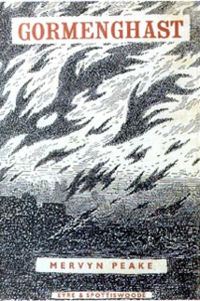
Rather than a sequel, Gormenghast is a continuation of Titus Groan. The first two books in the series fit together snugly like parts of a gargantuan novel that just gets better and better. The setting is still the ancient, vast and labyrinthine castle and we are reintroduced to Titus, seventy seventh Earl of Gormenghast. He’s now seven years old, and the book follows him through his childhood and into early adulthood. The narrative also picks up on the Machiavellian Steerpike, still working his way up through the ranks of the castle, and still resorting to manipulation and murder. Other characters surviving from the first novel include the eccentric Dr Prunesquallor and his very strange sister Irma, Titus’ lonely sister Fuchsia and Mister Flay, former servant to the Earl of Gormenghast.
Steerpike is now assistant to the ancient and formidable Barquentine, Master of Ritual, but plans to dispense with him at the earliest opportunity so he can take over the top job of overseeing the complex and mysterious rules and laws of Gormenghast. The young Titus, for whom these ancient procedures affect mostly, is already tired of the castle and dreams of escape. During his occasional wanders beyond the castle walls, he meets the banished Flay who now lives isolated in a semi-wild existence beyond the boundaries of Gormenghast. Flay is subsequently inspired to trespass the corridors of a deserted part of the castle and discovers the root of an evil that threatens to destroy the very foundations of Gormenghast itself…
Gormenghast manages to be both hilarious and deeply disturbing. I laughed out loud at the scenes involving Irma’s party, when she invites the entire cast of the castle’s eccentric and mostly elderly scoolmasters to her elaborate soirée in her search for an eligible husband. The chapters are as witty as anything Dickens has produced, perhaps even more so. Beneath the humour, Peake can also convey the despair at wasted and unfulfilled lives. It’s undeniably funny, but when Irma does find her match it’s still ultimately a grim life for her. All of the inhabitants of Gormenghast are trapped for life, and amongst them only Titus – ironically the most important of them all – longs to escape from the oppressing stone walls forever.
Steerpike’s descent into total evil provides the disturbing aspect of the book. In order to rid himself of his former accomplices, the mad sisters Cora and Clarice, he simply locks them away in a deserted part of the castle and forgets about them as they slowly starve to death. He’s a cold and calculating as you’d expect the best literary villain to be, and the scenes where Flay unwittingly eavesdrops on the sisters’ horrible fate are genuinely chilling, as are the last minutes of Barquentine’s life. The book is also genuinely moving, and the desperate and sudden suicide of one of the novel’s characters is an incredibly effective piece of writing.
Peake proves himself as a real master of suspense in this novel. He’s mapped out the entire castle in his mind, and brings to life every shadow, deserted corridor and forgotten room. Reading the book, I sat up half of the night racing through the chapters where the suspicious Flay, Prunesquallor and Titus follow Steerpike through the dark, endless and maze-like corridors. Excitement, curiosity and fear are evoked in the reader in equal proportions.
For the reader, The most satisfying aspect of Gormenghast is finally being able to decide on the heroes, villain and victims of the piece. Prunesquallor, only really a comic character in the first part, becomes believably and admirably heroic in the second, and Steerpike, although undeniably wicked, is always strangely compelling. We share his desires, his motives and his successes. And let’s not forget Fuchsia, who – although subtly drawn – is still one of literature’s truly tragic figures. I’ve still the last part, Titus Alone, to finish. I urge you to catch up with me and start reading now. It’s a work of genius.
Previous Page |
Next Page
