The film of Ian McEwan’s Atonement is a masterpiece – a true cinema classic.
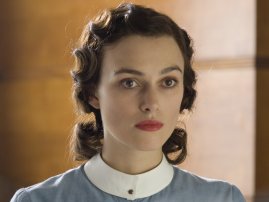
The 2001 novel is a favourite of mine, and Joe Wright (director) and Christopher Hampton (screenplay) lose nothing of the power and potency of the book. In many ways they succeed in improving upon it.
A blistering hot afternoon like yesterday might not be the best time for a trip to the cinema, but I have to take these chances when they come, and besides – like McEwan’s opening chapters the film brilliantly recreates a very similar summer day in 1935. Hot, still days where people think nothing of plunging into cool water; which is essentially what kickstarts the events in Atonement.
A young girl called Briony (Saoirse Ronan) witnesses three incidents that lead her to form conclusions surrounding a fourth. When her cousin is assaulted, she accuses a young man called Robbie Turner (James McAvoy) of the brutal deed. Wright emphasises the strength of fiction in Briony’s word and how her imagination can filter the truth into something else. The sound of typewriters echo through the film’s soundtrack, their sound hammering their importance in this story into us. And is is the typed word that gets Robbie into trouble; when a sexually explicit letter to Briony’s sister Cecilia (Keira Knightley) accidentally falls into Briony’s hands and she later witnesses a sexual encounter between Robbie and Cecilia – in a library, another world of fiction and shaped truths – her imagination goes into overload.
Following Robbie’s arrest the film jumps ahead to the wartime settings of London and Dunkirk. Anyone who has read the book knows to expect that things continue not to be as they seem and Wright really begins to shine here as an artist. The long sweeping shot of troops on the beach at Dunkirk is already becoming something of legend and it really is that good; the scene of Robbie walking through this hell-like vision is breathtaking – visually stunning and also managing to add to some of the intellectual themes of the book. Soldiers play at an abandoned funfair, a broken doll’s house sits abandoned, a ferris wheel turns oblivious to the devastation around it. I want to see this part of the movie again and again to fully appreciate its brilliance.
The film (like the book) will no doubt attract some criticism for its ending, which features Vanessa Redgrave as the now dying Briony, now a celebrated author, in the present day. We’re asked bluntly to think about truth and fiction, what we have just witnessed for two hours, how we would possibly want Briony’s ending to be any different. There is a stunning scene involving the 18 year old Briony (Romola Garai) – now a nurse in wartime London as part of her self-imposed atonement – and a dying French soldier that I think holds the key to the whole story. It’s about misunderstandings and lies, and how sometimes we can do nothing other than give in to them.
What’s best about the whole experience is that a great novel is turned into a fantastic and cinematically clever film. Visually, water plays a part in several key scenes. Cecilia diving into a pond to provide the beginning to Briony’s misunderstandings, Briony jumping into a river to force Robbie to rescue her, a final tragic scene during an air raid in London and the two lovers on an empty beach, embracing as the waves rush around them. This last image one of the most moving I have seen in cinema for some time.
Please see this film – there are excellent performances all round and Joe Wright is a director to watch in the future. It’s unadulterated rich, stunning cinema.
Are you a Goldilocks Kind of Reader?
Thursday September 6, 2007
in books | meme
From Booking Through Thursday:
Do you need the light just right, the background noise just so loud but not too loud, the chair just right, the distractions at a minimum?
Or can you open a book at any time and dip right in, whether it’s for twenty seconds, while waiting for the kettle to boil, or indefinitely, like while waiting interminably at the hospital–as long as the book is open in front of your nose, you’re happy to read?
If I’m engrossed in a book I can just about read it anywhere; queueing to check in at the airport, waiting for my daughter to decide on which pair of shoes to wear, that moment between pouring the hot water over the tea bag and pausing to take it out of the mug. The best book can almost possess you, so that it is with you at every waking moment – if you are not reading it in all of your spare minutes you might as well be because it will be occupying your thoughts anyway.
With a less enchanting book the distractions can give you excuses to not read it. The television in the next room isn’t really that loud, the cat doesn’t really want your attention, the choice of shoe isn’t really that unsuitable but they all combine to somehow release you from a dull book. The weaker read will fail but the best books will always overcome everything that’s buzzing around you.
Joseph Losey and The Damned
The director Joseph Losey is probably best known for his collaboration with Harold Pinter on the films The Servant (1963), Accident (1967) and The Go Between (1970). He also let his hair down for the curate’s egg that’s Modesty Blaise (1966). The Servant is possibly Losey’s best film, a brilliant monochrome study of the master and servant relationship turned very inside out and starring Dirk Bogarde and James Fox.
Although filmed two years earlier, Losey’s The Damned was also released in 1963. Made by Hammer, it was one of their psychological horrors of that decade. I watched it for the first time last week, one of the few Losey films I hitherto hadn’t had the pleasure of seeing, when it was shown by the BBC as part of their British Film Forever season. Throughout the summer, the Beeb have shown some obscure British films linked to their weekly genres of romance, costume drama, social realism, thriller, comedy, war and horror. Obscure choices possibly because they don’t currently have the rights to the films they’ve been covering in the accompanying documentaries (for example The Servant, as well as other obvious British favourites such as Get Carter, If… and A Clockwork Orange), but the unusual selection is welcome because I’ve had a chance to see a lot of criminally underexposed gems. Films such as Sidney J. Furie’s The Leather Boys (1964), Michael Reeves’ The Sorcerers (1967) and Losey’s The Damned…
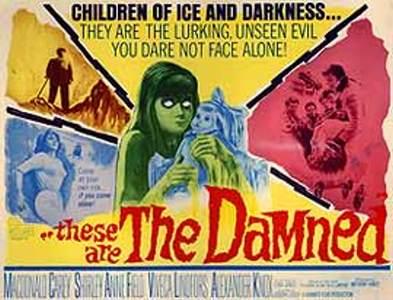
Filmed in black and white, The Damned has an Anglo-American cast, the most recognisable actor being the young Oliver Reed. Reed is a favourite of mine, although I heartily concede that he has a very unusual acting style. He’s good in films like this, that require little or no elements of a naturalistic performance. He’s best on broody, which he does magnificently here. Think of a warm up for his Bill Sykes in Oliver!.
Reed plays an edgy leader of a seaside motorcycle gang, who take exception to his sister (Shirley Anne Field) becoming involved with an older man (Macdonald Carey). What’s looking decidedly run of the mill suddenly takes a weirder turn when our three leads stumble across a sinister military base where a group of children are apparently held captive. What follows is an eerie science fiction film with dashes of horror.
For audiences in the early 60s, the makers of The Damned play on the apparent inevitibility that Mankind is going to be destroyed by a nuclear bomb. It’s sooner rather than later in everybody’s expectation, or when the time comes as the children menacingly predict. Cue a plot development where the group of youngsters turn out to be a bunch of radioactive pre-teens kept to survive the bomb and inherit the Earth. Cue great early 60s sci-fi. Cue lots of effective eye-rolling from Reed.
The Damned is quite dated now, but the script is above average for this type of film and Losey’s direction shines as usual. The children reminded me of the youngsters in Village of the Damned, a film based on a John Wyndham story, and although more use should have been made of them (perhaps a little too much preliminary eye-rolling gets in the way) the film develops quite darkly and manages to ask awkward questions about incest, impotency and death. There’s also an infuriatingly catchy theme tune. Not bad for a Hammer B-movie.
Previous Page |
Next Page
